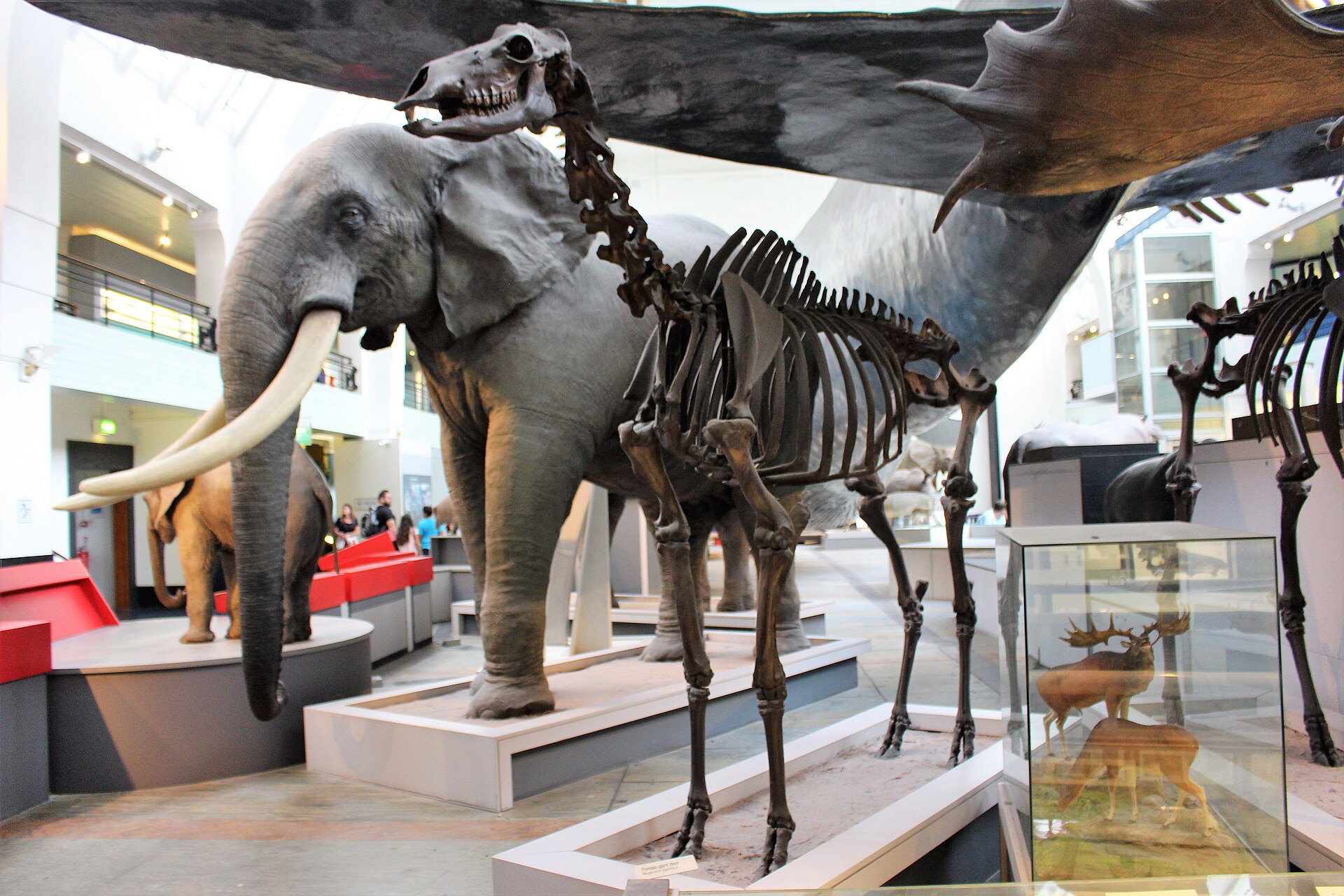
Giant deer — Megaloceros giganteus
Geologic period: Quaternary — Late Pleistocene
Age: The Smithsonian Deep Time specimen from Ireland lived approximately 15,200 to 11,100 years ago.
Taxonomic note: Despite the nickname 'Irish elk,' Megaloceros was a deer and ranged far beyond Ireland.
Feeding: Herbivorous.
Evidence: The skeleton and antlers are direct fossil evidence. The exact balance of display, competition and other selective pressures on antler evolution remains interpreted.
Why it matters: Megaloceros provides a powerful example of Ice Age megafauna and of how spectacular structures evolve under ecological and reproductive pressures.
Plain Language Identity: A giant Pleistocene deer of Eurasia, often misleadingly called the Irish elk.
What You Are Looking At: A complete mounted skeleton bearing the enormous antlers of Megaloceros giganteus.
Ecosystem: Late Pleistocene Eurasian grassland and open woodland ecosystems.
Source Urls: https://naturalhistory.si.edu/visit/virtual-tour/current-exhibits/deep-time-virtual-tour-fossil-list; https://www.si.edu/object/megaloceros-giganteus-blumenbach:nmnhpaleobiology_3447793; https://www.si.edu/newsdesk/factsheets/david-h-koch-hall-fossils-deep-time
Find Location: Ireland for the Smithsonian mounted specimen.
Enrichment Method: SAGE curated research pass; title + scientific name + source scene matched; chronology and taxonomy conflicts retained rather than silently corrected; evidence separated from inference
Scientific name: Megaloceros giganteus
Evidence / representation: comparative_skeletal_mount
comparative_skeletal_mount
After the Dinosaurs: Mammals, Ice Ages and the World We Inherited.
Media license: CC BY-SA 4.0
https://creativecommons.org/licenses/by-sa/4.0
This object page stays inside SAGE Museum. The Smithsonian link below is provided only as the original scholarly collection record. It opens separately.
VIEW ORIGINAL SMITHSONIAN RECORD ↗