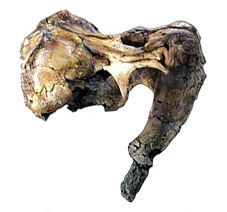
Walrus-whale — Odobenocetops peruvianus
Geologic period: Pliocene
Age: Early Pliocene for the species; Smithsonian material comes from the Pisco Formation of Peru.
Feeding: Benthic feeding is strongly inferred from cranial anatomy.
Evidence: The specialized skull, palate and tusks are fossil evidence. Walrus-like feeding behavior is an anatomical interpretation.
Why it matters: Odobenocetops is a dramatic example of convergent evolution: a whale lineage independently evolved features resembling those of walruses.
Plain Language Identity: A bizarre Pliocene toothed whale that evolved a skull strikingly convergent with modern walruses.
What You Are Looking At: A cast of the unusual skull with tusks of Odobenocetops peruvianus.
Ecosystem: Pliocene marine ecosystem of coastal Peru.
Source Urls: https://naturalhistory.si.edu/visit/virtual-tour/current-exhibits/deep-time-virtual-tour-fossil-list; https://www.si.edu/es/object/3d/odobenocetops-peruvianus-de-muizon:3b896f42-b8f5-4798-af90-ad46e5d9fcb3; https://repository.si.edu/items/c4f6eb65-6eed-4e6c-b769-a3f19f08933f
Formation: Pisco Formation
Find Location: Peru
Enrichment Method: SAGE curated research pass; title + scientific name + source scene matched; chronology and taxonomy conflicts retained rather than silently corrected; evidence separated from inference
Scientific name: Odobenocetops peruvianus
Evidence / representation: comparative_taxon_visual
comparative_taxon_visual
After the Dinosaurs: Mammals, Ice Ages and the World We Inherited.
Media license: CC BY 4.0
https://creativecommons.org/licenses/by/4.0
This object page stays inside SAGE Museum. The Smithsonian link below is provided only as the original scholarly collection record. It opens separately.
VIEW ORIGINAL SMITHSONIAN RECORD ↗