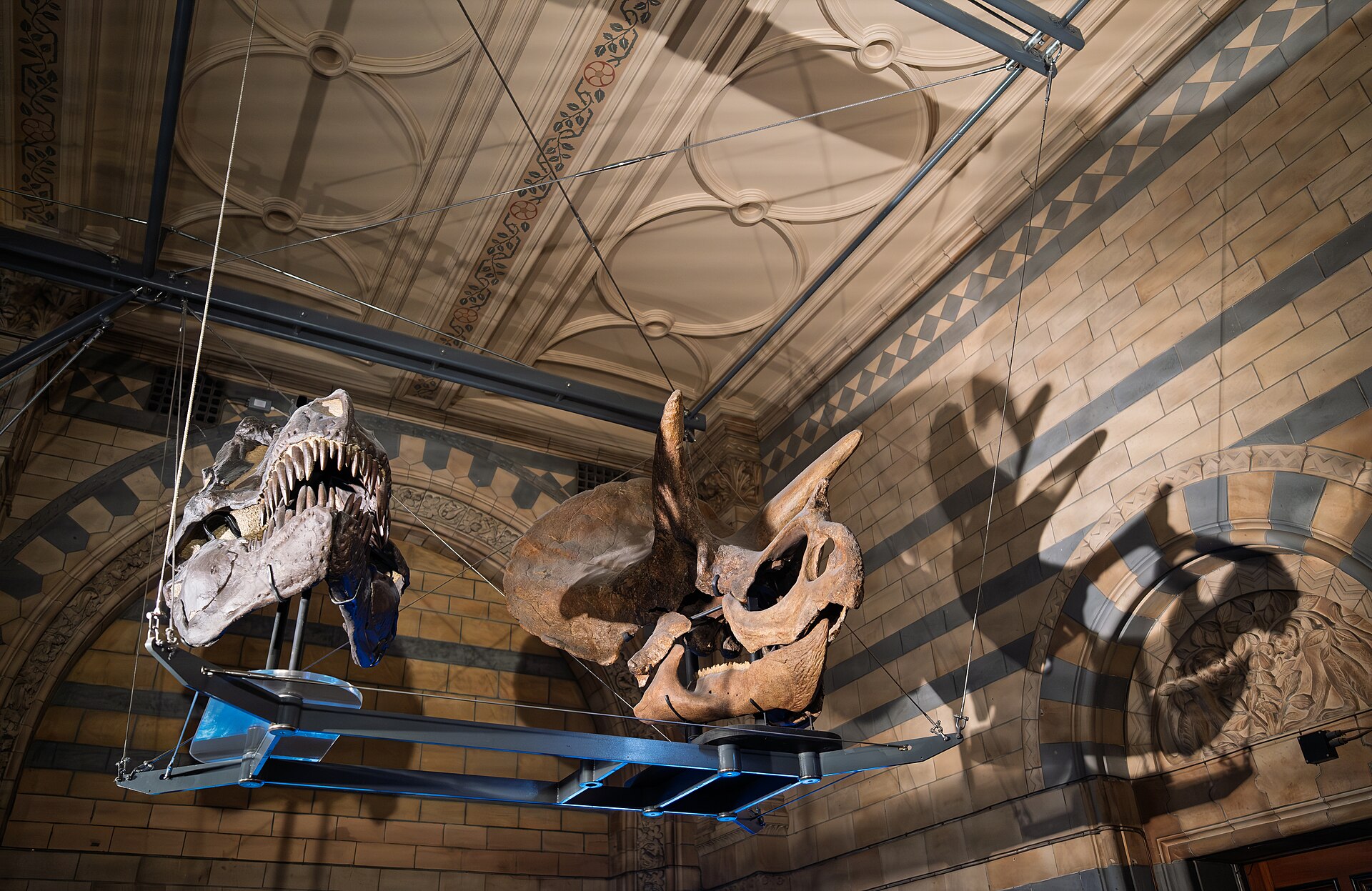
Tyrannosaurus rex and Triceratops — Tyrannosaurus rex and Triceratops horridus
Geologic period: Latest Cretaceous — Maastrichtian
Age: Approximately 68 to 66 million years ago for Tyrannosaurus rex; both genera lived near the end of the Cretaceous in western North America.
Feeding: Tyrannosaurus was carnivorous; Triceratops was herbivorous.
Locomotion: Tyrannosaurus moved bipedally. Triceratops moved quadrupedally.
Body plan: Tyrannosaurus was a giant bipedal theropod predator. Triceratops was a large quadrupedal horned herbivore.
Evidence: The skeletal anatomy of each taxon is direct fossil evidence. Independent fossils also document tyrannosaur feeding on large herbivorous dinosaurs. The exact interaction posed between these mounted individuals is a reconstruction.
Why it matters: The pairing introduces one of the most famous predator and herbivore combinations in dinosaur history while also teaching visitors to distinguish fossil evidence from dramatic museum staging.
Plain Language Identity: The flagship Deep Time pairing of Tyrannosaurus rex and Triceratops horridus, two large dinosaurs from the very end of the Cretaceous.
What You Are Looking At: Mounted skeletal material arranged as a dramatic feeding interaction between T. rex and Triceratops.
Defense Or Attack: Tyrannosaurus possessed powerful jaws and robust teeth. Triceratops possessed large brow horns, a nasal horn and a massive frilled skull.
Ecosystem: Latest Cretaceous western North American terrestrial ecosystems.
Preservation: Mounted fossil exhibit with reconstructed pose.
Display Context Note: The feeding pose is museum interpretation. It must not be presented as evidence that these exact mounted individuals met, fought or fed upon one another.
Open Questions: Specific behavior in the staged encounter is not directly known.
Source Urls: https://naturalhistory.si.edu/visit/virtual-tour/current-exhibits/deep-time-virtual-tour-fossil-list; https://www.smithsonianmag.com/smithsonian-institution/nations-t-rex-prepares-make-smithsonian-debut-180972194/; https://www.smithsonianmag.com/blogs/national-museum-of-natural-history/2021/09/07/what-weve-discovered-about-tyrant-lizard-king-nations-t-rex-was-unearthed/
Enrichment Method: SAGE curated research pass; title + scientific name + source scene matched; display reconstruction separated from evidence; provenance uncertainty retained
Scientific name: Tyrannosaurus rex and Triceratops horridus
Evidence / representation: comparative_taxon_visual
comparative_taxon_visual
T. rex & Triceratops: The Last American Dinosaur World.
Media license: CC BY-SA 4.0
https://creativecommons.org/licenses/by-sa/4.0
This object page stays inside SAGE Museum. The Smithsonian link below is provided only as the original scholarly collection record. It opens separately.
VIEW ORIGINAL SMITHSONIAN RECORD ↗