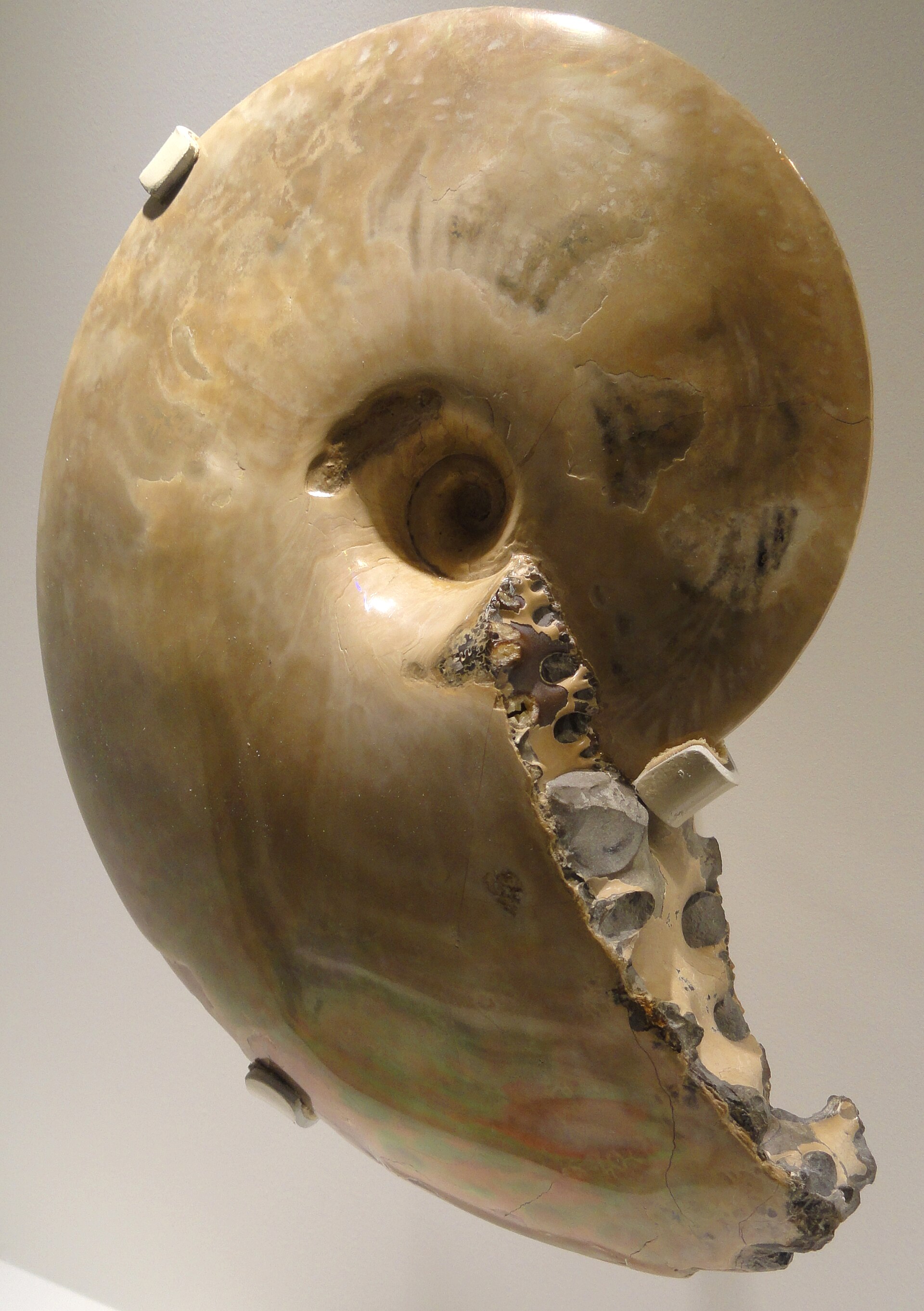
Ammonite cephalopod — Placenticeras meeki
Geologic period: Late Cretaceous — Campanian
Age: Late Cretaceous, Campanian.
Feeding: Marine feeding ecology is inferred from ammonite anatomy and comparison with cephalopods; the soft feeding apparatus is not preserved in this shell.
Locomotion: Marine swimming using buoyancy control and jet propulsion is reconstructed from cephalopod biology and shell form.
Body plan: Planispirally coiled chambered shell surrounding a soft-bodied cephalopod.
Evidence: Shell shape, chambers and sutures are direct evidence. Soft-body reconstruction remains inferential.
Why it matters: Ammonites were abundant and diverse marine animals and are extremely useful for understanding and correlating Cretaceous marine rock layers.
Plain Language Identity: A coiled ammonite cephalopod from Late Cretaceous seas.
What You Are Looking At: A fossil chambered shell belonging to Placenticeras meeki.
Ecosystem: Late Cretaceous Western Interior Seaway.
Formation: Pierre Shale for documented Smithsonian material.
Find Location: South Dakota, United States for documented Smithsonian material.
Preservation: Mineralized or mold-preserved shell fossil.
Open Questions: Do not reconstruct exact soft-tissue color or behavior as direct evidence.
Source Urls: https://naturalhistory.si.edu/visit/virtual-tour/current-exhibits/deep-time-virtual-tour-fossil-list; https://nmaahc.si.edu/object/nmnhpaleobiology_3188007
Enrichment Method: SAGE curated research pass; title + scientific name + source scene matched; comparative chronology retained; evidence separated from inference
Scientific name: Placenticeras meeki
Evidence / representation: comparative_taxon_visual
comparative_taxon_visual
Cretaceous Worlds: Dinosaurs at Their Most Diverse.
Media license: CC0
http://creativecommons.org/publicdomain/zero/1.0/deed.en
This object page stays inside SAGE Museum. The Smithsonian link below is provided only as the original scholarly collection record. It opens separately.
VIEW ORIGINAL SMITHSONIAN RECORD ↗