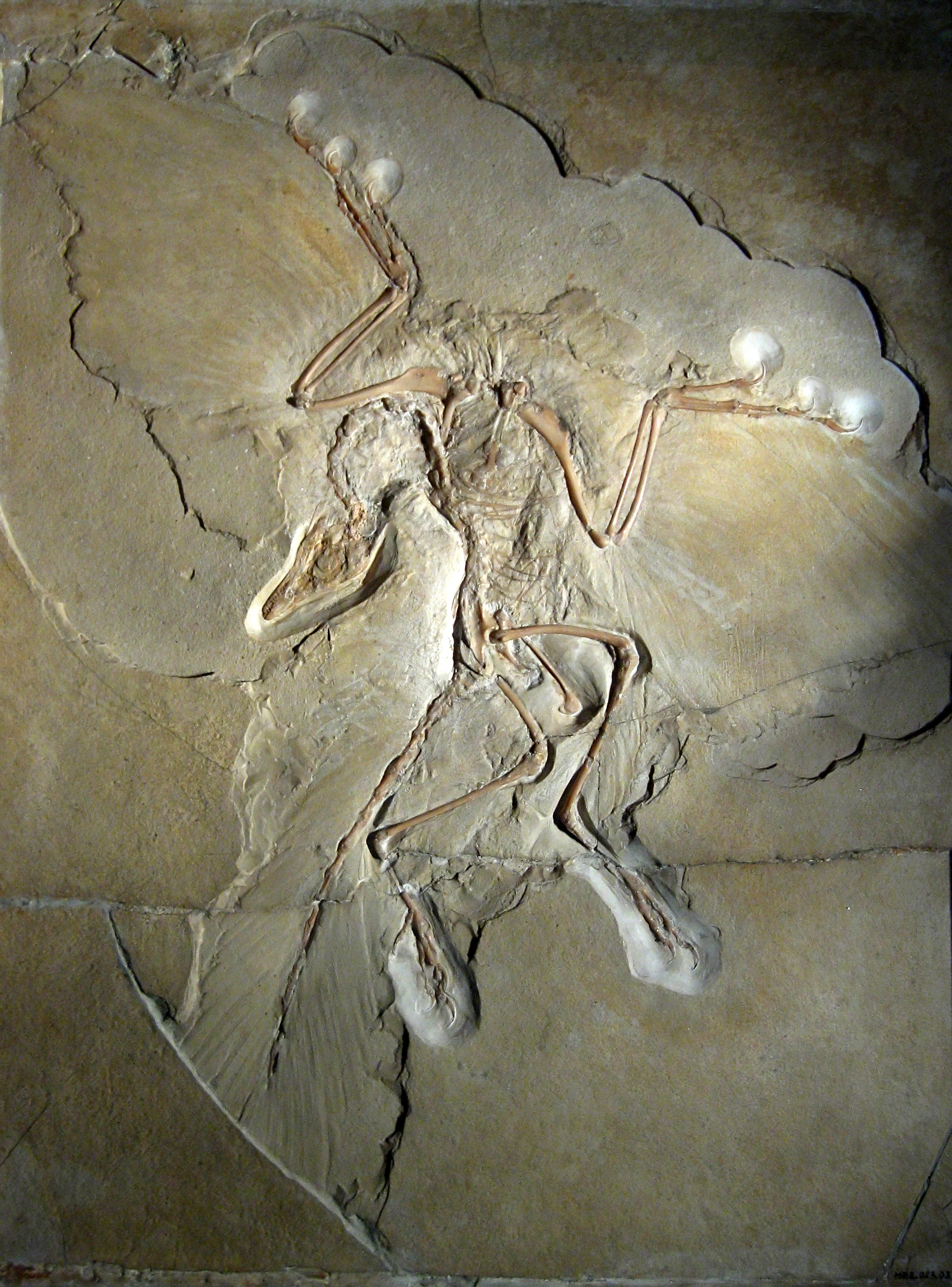
Early toothed bird — Archaeopteryx lithographica
Geologic period: Late Jurassic — comparative predecessor
Age: Late Jurassic, roughly 150 million years ago.
Feeding: Predatory or faunivorous feeding is inferred from teeth and skeletal anatomy.
Locomotion: Aerial capability is strongly supported, though the exact style and power of flight remain researched.
Body plan: Feathered animal with wings, a long bony tail, clawed fingers and toothed jaws.
Evidence: Feathers, toothed jaws, long tail and limb anatomy are direct fossil evidence.
Why it matters: Archaeopteryx remains one of the clearest classic examples of the anatomical transition between non-avian theropods and early birds.
Plain Language Identity: A Late Jurassic feathered avialan from Germany placed here as a comparative predecessor in the bird-origins story.
What You Are Looking At: A cast based on Archaeopteryx fossil material preserving a mixture of bird-like and non-avian theropod features.
Ecosystem: Late Jurassic Solnhofen archipelago environment.
Formation: Solnhofen Limestone.
Find Location: Bavaria, Germany.
Preservation: Visitor object is a cast.
Room Context Note: Archaeopteryx is Jurassic, not Cretaceous. It is intentionally retained in Room 07 only as a comparative bird-origins predecessor and must be visually labeled that way.
Open Questions: Do not present Archaeopteryx as the single direct ancestor of every living bird.
Source Urls: https://naturalhistory.si.edu/visit/virtual-tour/current-exhibits/deep-time-virtual-tour-fossil-list; https://www.si.edu/object/archaeopteryx-lithographica-meyer:nmnhpaleobiology_3370799
Enrichment Method: SAGE curated research pass; title + scientific name + source scene matched; comparative chronology retained; evidence separated from inference
Scientific name: Archaeopteryx lithographica
Evidence / representation: comparative_original_fossil_visual
comparative_original_fossil_visual
Cretaceous Worlds: Dinosaurs at Their Most Diverse.
Media license: CC BY-SA 3.0
https://creativecommons.org/licenses/by-sa/3.0
This object page stays inside SAGE Museum. The Smithsonian link below is provided only as the original scholarly collection record. It opens separately.
VIEW ORIGINAL SMITHSONIAN RECORD ↗