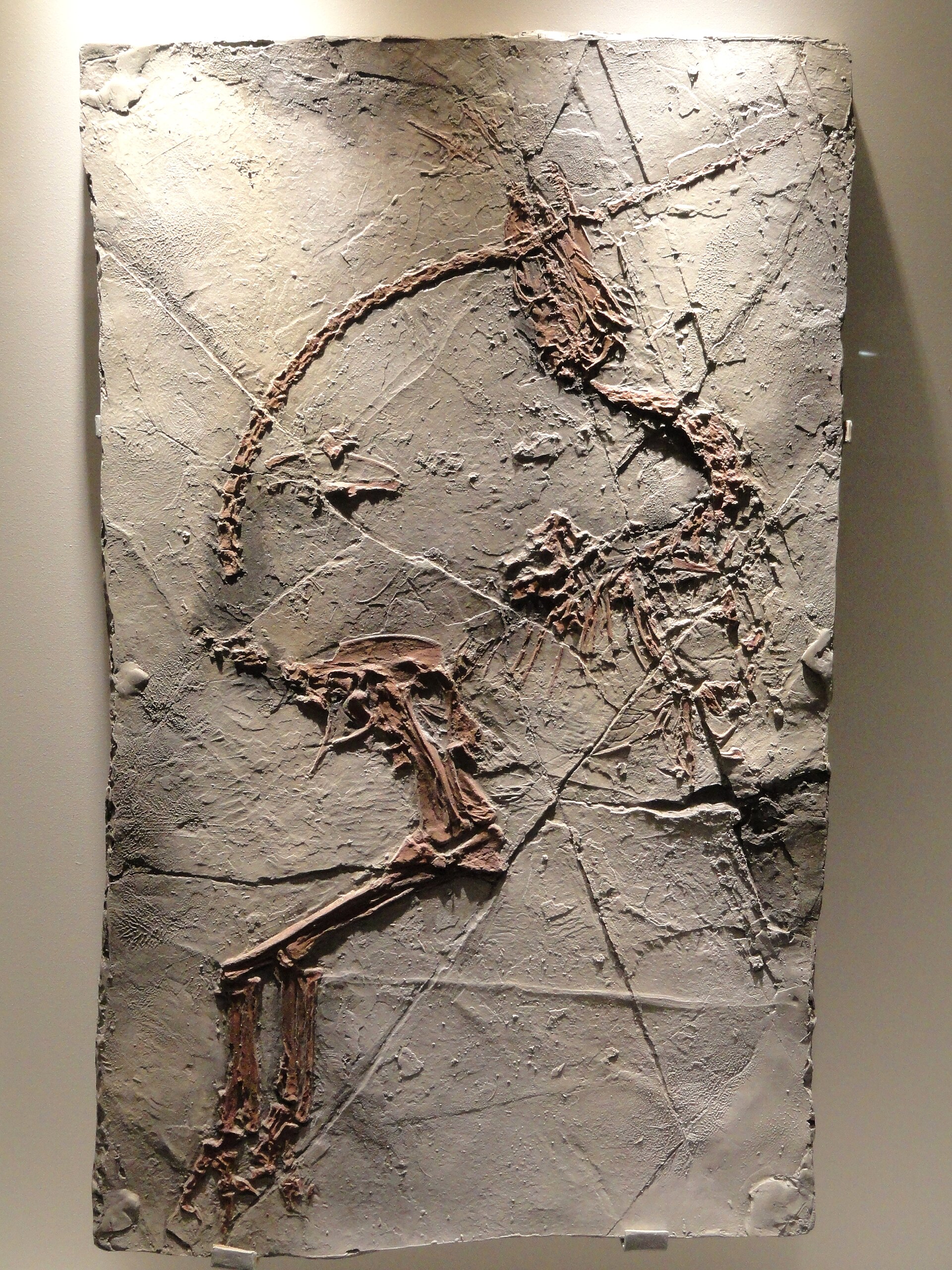
Feathered theropod dinosaur — Sinosauropteryx prima
Geologic period: Early Cretaceous — Aptian
Age: Approximately 130 to 125 million years ago.
Feeding: Carnivorous.
Locomotion: Bipedal terrestrial locomotion.
Body plan: Small bipedal theropod with a long tail, short forelimbs and a covering of simple filamentous feathers.
Evidence: Skeleton and feather impressions are direct. Melanosome and pigment distributions support reconstruction of countershading and tail banding.
Why it matters: Sinosauropteryx was among the first non-avian dinosaurs found with clear feather-like structures, and preserved pigment evidence allows unusually detailed color-pattern studies.
Plain Language Identity: A small feathered theropod from Early Cretaceous China.
What You Are Looking At: A cast based on an exceptionally preserved skeleton with filamentous feather-like integument.
Ecosystem: Early Cretaceous Jehol Biota of northeastern China.
Formation: Yixian Formation.
Find Location: China.
Preservation: Visitor object is a cast based on exceptionally preserved fossils.
Open Questions: Reconstructed color pattern should remain tied to the specific preserved pigment evidence rather than artistic invention.
Source Urls: https://naturalhistory.si.edu/visit/virtual-tour/current-exhibits/deep-time-virtual-tour-fossil-list; https://www.si.edu/object/nmnhpaleobiology_12307249; https://australian.museum/learn/dinosaurs/fact-sheets/sinosauropteryx-prima/
Enrichment Method: SAGE curated research pass; title + scientific name + source scene matched; comparative chronology retained; evidence separated from inference
Scientific name: Sinosauropteryx prima
Evidence / representation: comparative_taxon_visual
comparative_taxon_visual
Cretaceous Worlds: Dinosaurs at Their Most Diverse.
Media license: CC0
http://creativecommons.org/publicdomain/zero/1.0/deed.en
This object page stays inside SAGE Museum. The Smithsonian link below is provided only as the original scholarly collection record. It opens separately.
VIEW ORIGINAL SMITHSONIAN RECORD ↗