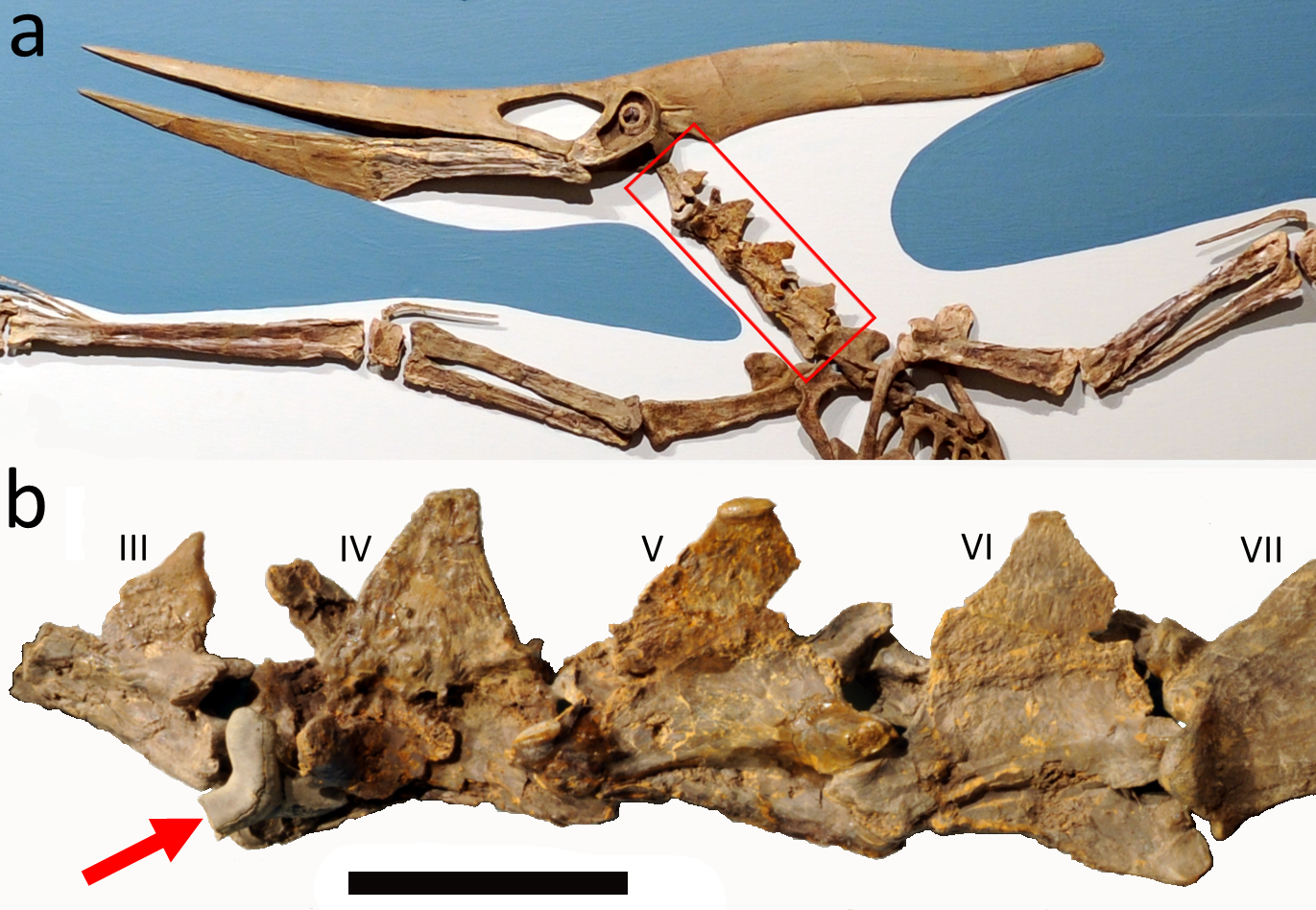
Pterosaur — Pteranodon sp.
Geologic period: Late Cretaceous — Santonian for documented Smithsonian material
Age: Late Cretaceous.
Feeding: Marine feeding, commonly interpreted as fish-focused.
Locomotion: Powered flight and soaring.
Body plan: Large flying reptile with long narrow wings, toothless jaws and a prominent cranial crest in many individuals.
Evidence: Wing bones and skull anatomy are direct evidence. Flight performance is reconstructed biomechanically.
Why it matters: Pteranodon lets visitors compare three independent flight solutions: pterosaurs, birds and later bats.
Plain Language Identity: A large toothless Late Cretaceous pterosaur from the Western Interior Seaway.
What You Are Looking At: Pteranodon fossil material used in the flight-evolution comparison.
Ecosystem: Western Interior Seaway.
Formation: Niobrara Formation for documented Smithsonian specimens.
Find Location: Kansas, United States for documented Smithsonian material.
Preservation: Original fossil material.
Open Questions: Pteranodon was not a dinosaur and not a bird.
Source Urls: https://naturalhistory.si.edu/visit/virtual-tour/current-exhibits/deep-time-virtual-tour-fossil-list; https://www.si.edu/object/nmnhpaleobiology_3447912
Enrichment Method: SAGE curated research pass; title + scientific name + source scene matched; comparative chronology retained; evidence separated from inference
Scientific name: Pteranodon sp.
Evidence / representation: comparative_taxon_visual
comparative_taxon_visual
Cretaceous Worlds: Dinosaurs at Their Most Diverse.
Media license: CC BY 4.0
https://creativecommons.org/licenses/by/4.0
This object page stays inside SAGE Museum. The Smithsonian link below is provided only as the original scholarly collection record. It opens separately.
VIEW ORIGINAL SMITHSONIAN RECORD ↗