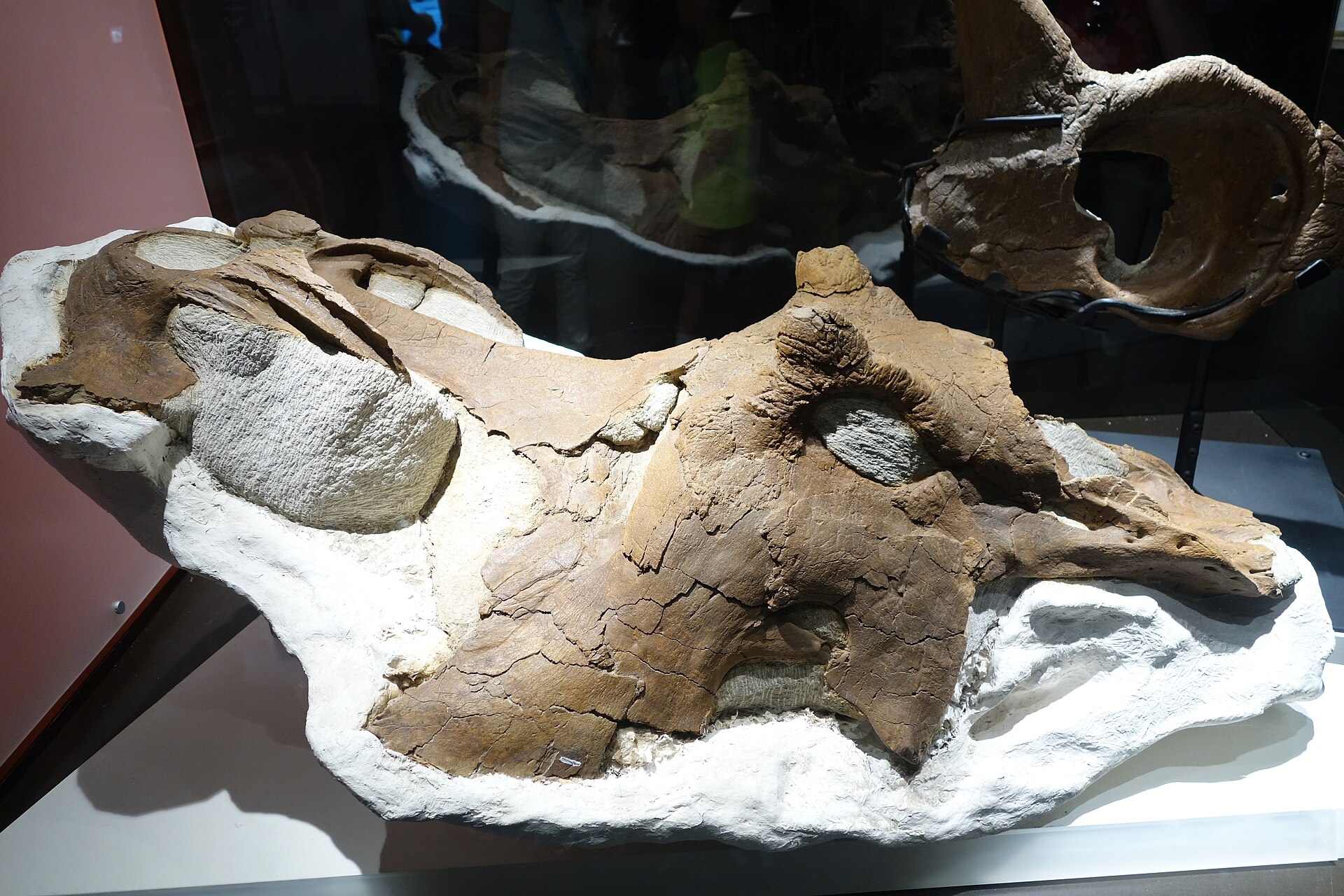
Ceratopsian dinosaur — Centrosaurus apertus
Geologic period: Late Cretaceous — Campanian
Age: Late Cretaceous, Campanian.
Feeding: Herbivorous.
Locomotion: Terrestrial quadruped.
Body plan: Large quadrupedal herbivore with a beaked skull, prominent nasal horn and elaborate bony frill.
Evidence: Complete skull anatomy is direct evidence.
Why it matters: Centrosaurus allows the exhibit to separate what fossils show directly—horn and frill anatomy—from hypotheses about combat, display and species recognition.
Plain Language Identity: A horned centrosaurine ceratopsid from the Campanian of Alberta.
What You Are Looking At: A complete mounted Centrosaurus apertus skull.
Defense Or Attack: Horn and frill had possible defensive and display roles; their behavioral use was likely complex.
Ecosystem: Dinosaur Park Formation ecosystem.
Formation: Dinosaur Park Formation.
Find Location: Alberta, Canada.
Preservation: Original mounted fossil skull.
Open Questions: No single behavioral explanation for every horn and frill feature should be presented as certain.
Source Urls: https://naturalhistory.si.edu/visit/virtual-tour/current-exhibits/deep-time-virtual-tour-fossil-list; https://www.si.edu/object/centrosaurus-apertus-lambe-1904:nmnhpaleobiology_3383668
Enrichment Method: SAGE curated research pass; title + scientific name + source scene matched; comparative chronology retained; evidence separated from inference
Scientific name: Centrosaurus apertus
Evidence / representation: comparative_original_skull_visual
comparative_original_skull_visual
Cretaceous Worlds: Dinosaurs at Their Most Diverse.
Media license: CC BY-SA 4.0
https://creativecommons.org/licenses/by-sa/4.0
This object page stays inside SAGE Museum. The Smithsonian link below is provided only as the original scholarly collection record. It opens separately.
VIEW ORIGINAL SMITHSONIAN RECORD ↗