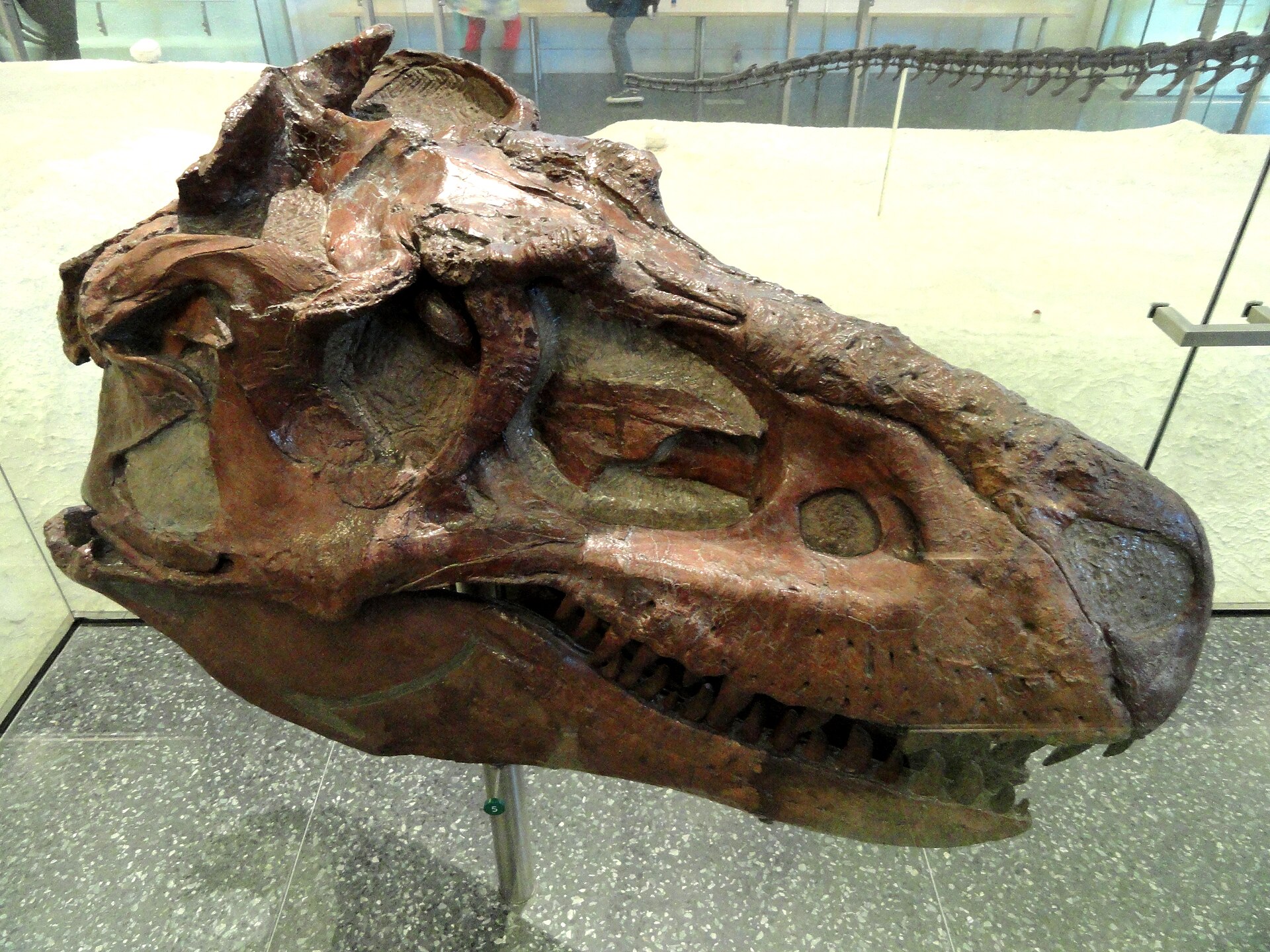
Theropod dinosaur — Gorgosaurus libratus
Geologic period: Late Cretaceous — Campanian
Age: Late Cretaceous, Campanian.
Feeding: Carnivorous.
Locomotion: Bipedal terrestrial locomotion.
Body plan: Large bipedal tyrannosaurid with a deep skull, powerful hind limbs and reduced two-fingered forelimbs.
Evidence: Skull and tooth anatomy are direct fossil evidence. Hunting strategies remain reconstructed.
Why it matters: Gorgosaurus shows that sophisticated tyrannosaurid predators were already established millions of years before T. rex.
Plain Language Identity: A large Campanian tyrannosaurid predator closely related to later Tyrannosaurus.
What You Are Looking At: A fossil skull of Gorgosaurus libratus.
Defense Or Attack: Large jaws and robust teeth were its primary prey-capture system.
Ecosystem: Late Cretaceous western North American terrestrial ecosystems.
Formation: Dinosaur Park Formation for documented Smithsonian material.
Find Location: Alberta, Canada.
Preservation: Original fossil skull.
Open Questions: Do not turn Gorgosaurus into a smaller T. rex clone; it belongs to a distinct tyrannosaurid genus.
Source Urls: https://naturalhistory.si.edu/visit/virtual-tour/current-exhibits/deep-time-virtual-tour-fossil-list; https://www.si.edu/object/nmnhpaleobiology_3451251
Enrichment Method: SAGE curated research pass; title + scientific name + source scene matched; comparative chronology retained; evidence separated from inference
Scientific name: Gorgosaurus libratus
Evidence / representation: comparative_exact_taxon_skull_visual
comparative_exact_taxon_skull_visual
Cretaceous Worlds: Dinosaurs at Their Most Diverse.
Media license: CC0
http://creativecommons.org/publicdomain/zero/1.0/deed.en
This object page stays inside SAGE Museum. The Smithsonian link below is provided only as the original scholarly collection record. It opens separately.
VIEW ORIGINAL SMITHSONIAN RECORD ↗