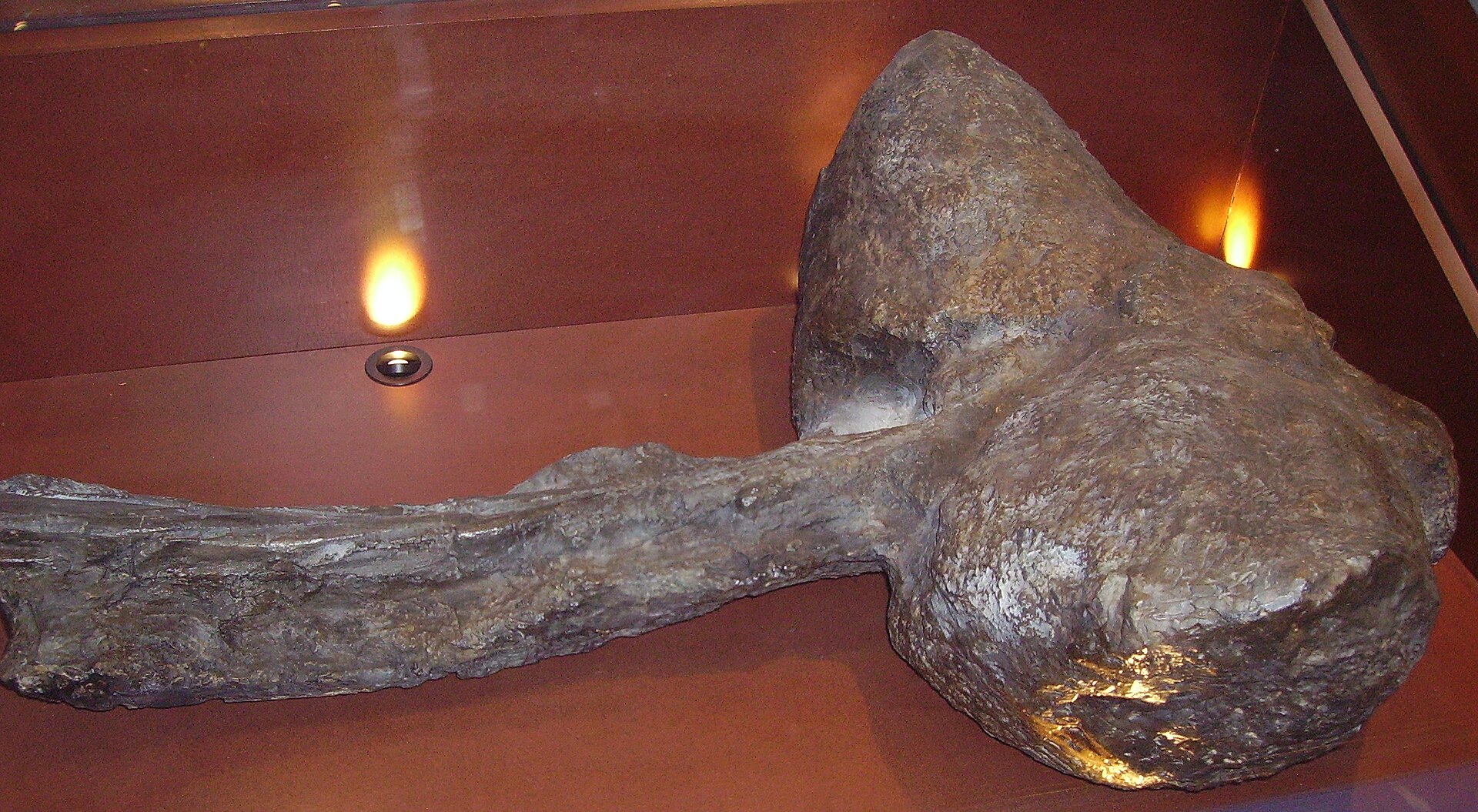
Ankylosaurian dinosaur — Anodontosaurus lambei
Geologic period: Late Cretaceous — Maastrichtian
Age: Late Cretaceous, Maastrichtian for the documented Smithsonian specimen.
Feeding: Herbivorous.
Locomotion: Terrestrial quadruped.
Body plan: Low-slung quadrupedal herbivore covered in osteoderms and equipped with a stiffened tail ending in a bony club.
Evidence: Tail vertebrae and club anatomy are direct evidence. How frequently the club was used in combat remains inferred.
Why it matters: The tail club provides direct evidence that ankylosaurids evolved highly specialized defensive anatomy.
Plain Language Identity: A heavily armored ankylosaurid dinosaur represented by its specialized tail-club anatomy.
What You Are Looking At: Distal tail anatomy from Anodontosaurus lambei forming part of the ankylosaurid tail weapon.
Defense Or Attack: The reinforced tail and terminal club formed a powerful defensive structure.
Ecosystem: Latest Cretaceous terrestrial environments of Alberta.
Formation: Horseshoe Canyon Formation.
Find Location: Alberta, Canada.
Preservation: Original fossil tail anatomy.
Research History: Anodontosaurus material was historically folded into Euoplocephalus before later taxonomic revision restored Anodontosaurus as a distinct genus.
Open Questions: Do not merge Anodontosaurus and Euoplocephalus simply because older museum records sometimes did.
Source Urls: https://naturalhistory.si.edu/visit/virtual-tour/current-exhibits/deep-time-virtual-tour-fossil-list; https://www.si.edu/object/nmnhpaleobiology_3342143
Enrichment Method: SAGE curated research pass; title + scientific name + source scene matched; comparative chronology retained; evidence separated from inference
Scientific name: Anodontosaurus lambei
Evidence / representation: comparative_cast_visual
comparative_cast_visual
Cretaceous Worlds: Dinosaurs at Their Most Diverse.
Media license: CC BY-SA 3.0
http://creativecommons.org/licenses/by-sa/3.0/
This object page stays inside SAGE Museum. The Smithsonian link below is provided only as the original scholarly collection record. It opens separately.
VIEW ORIGINAL SMITHSONIAN RECORD ↗