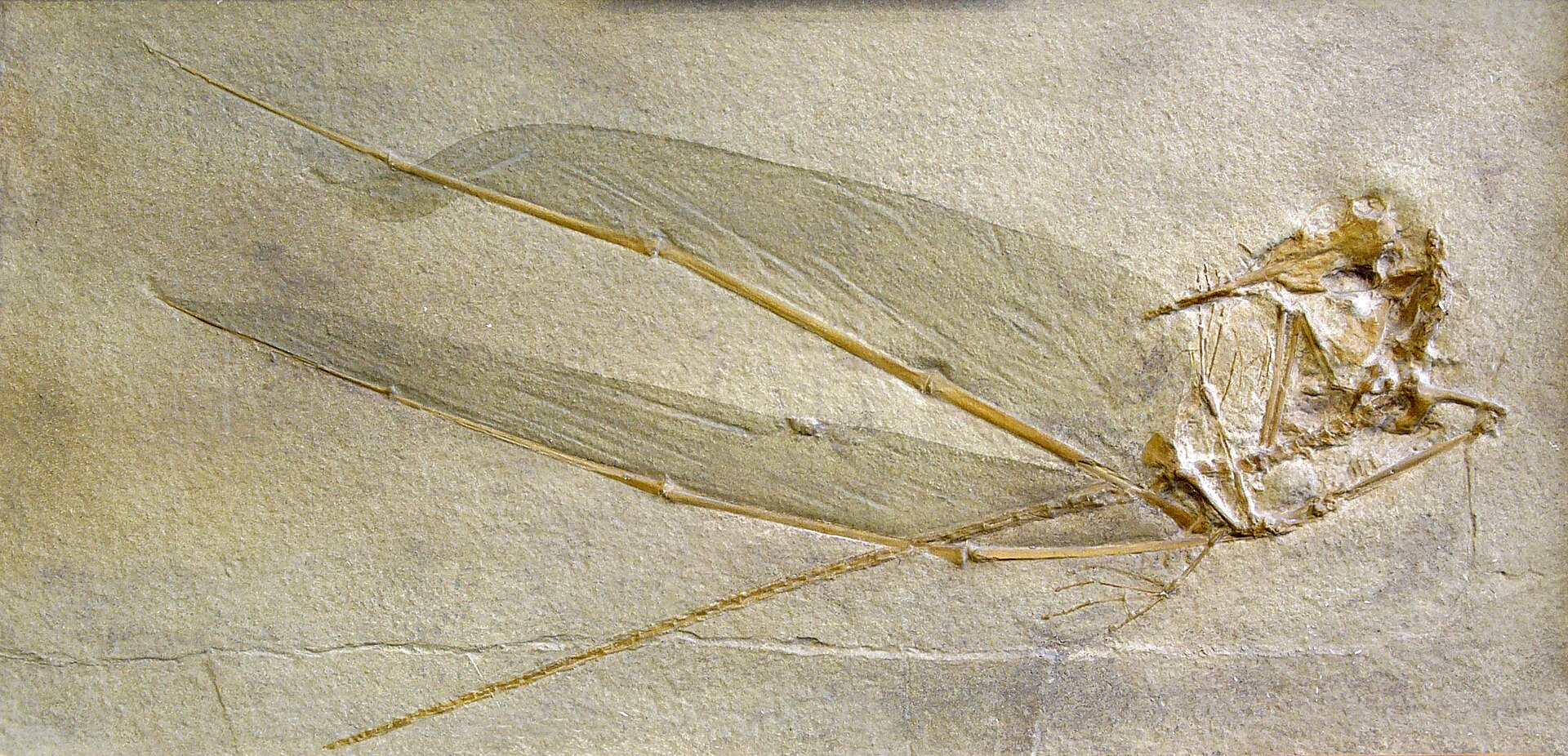
Pterosaur flying reptile — Rhamphorhynchus muensteri
Geologic period: Late Jurassic
Age: Approximately 153 to 151 million years ago in the Smithsonian Deep Time interpretation.
Feeding: Predatory feeding on small aquatic or terrestrial prey is inferred from anatomy and related evidence.
Locomotion: Powered flight.
Body plan: Lightweight flying reptile with a long tail and a membrane wing supported primarily by an elongated fourth finger.
Evidence: Skeleton and wing impressions are direct fossil evidence.
Why it matters: Soft-tissue wing impressions let visitors see evidence normally lost during fossilization and explain exactly how pterosaur wings differed from bird and bat wings.
Plain Language Identity: A Late Jurassic long-tailed pterosaur preserved with rare impressions of its wing membranes.
What You Are Looking At: A nearly complete fossil skeleton preserving impressions of the soft wing membranes.
Ecosystem: Late Jurassic Solnhofen lagoon environment of Germany.
Find Location: Germany.
Preservation: Exceptional skeleton with soft-tissue impressions.
Open Questions: Pterosaurs were flying reptiles, not flying dinosaurs.
Source Urls: https://naturalhistory.si.edu/visit/virtual-tour/current-exhibits/deep-time-virtual-tour-fossil-list; https://www.si.edu/newsdesk/factsheets/david-h-koch-hall-fossils-deep-time; https://www.nhm.ac.uk/discover/the-truth-about-pterosaurs.html
Enrichment Method: SAGE curated research pass; title + scientific name + source scene matched; historic taxonomy retained where relevant; evidence separated from inference
Scientific name: Rhamphorhynchus muensteri
Evidence / representation: comparative_taxon_visual
comparative_taxon_visual
Jurassic Giants: Size, Teeth, Armor and Survival.
Media license: CC BY 3.0
https://creativecommons.org/licenses/by/3.0
This object page stays inside SAGE Museum. The Smithsonian link below is provided only as the original scholarly collection record. It opens separately.
VIEW ORIGINAL SMITHSONIAN RECORD ↗