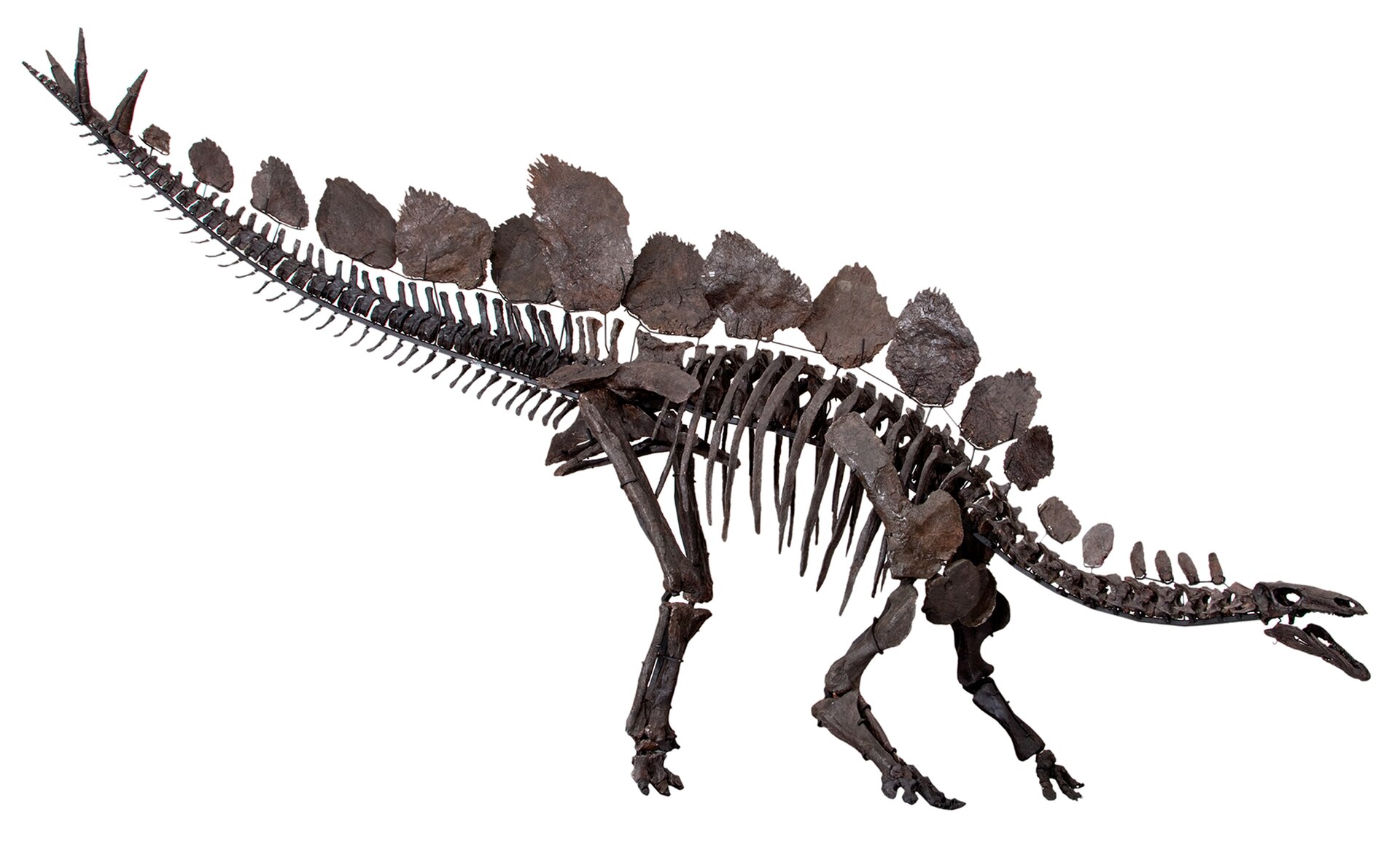
Stegosaur type specimen — Stegosaurus stenops
Geologic period: Late Jurassic — Kimmeridgian
Age: Approximately 152 million years old.
Feeding: Herbivorous.
Locomotion: Terrestrial quadruped.
Body plan: Nearly complete plated dinosaur skeleton preserving much of the anatomy used to define Stegosaurus stenops.
Evidence: The Smithsonian catalog records this specimen as the holotype and an exceptionally complete mounted skeleton.
Why it matters: A type specimen is not merely another fossil. It is the physical scientific standard tied to the formal definition of a species.
Discovery context: Collected at the Felch-Marsh Quarry in 1886 and designated as the holotype of Stegosaurus stenops.
Plain Language Identity: The holotype specimen of Stegosaurus stenops—the reference specimen on which the species name is based.
What You Are Looking At: An exceptionally complete original Stegosaurus skeleton displayed in association with its scientific preparation and research history.
Ecosystem: Late Jurassic Morrison Formation.
Formation: Morrison Formation — Brushy Basin Member.
Find Location: Fremont County, Colorado, United States.
Preservation: Original fossil skeleton.
Open Questions: Reconstruction of missing soft tissue and coloration remains interpretive even when the skeleton is unusually complete.
Source Urls: https://naturalhistory.si.edu/visit/virtual-tour/current-exhibits/deep-time-virtual-tour-fossil-list; https://www.si.edu/object/nmnhpaleobiology_3448873; https://www.si.edu/newsdesk/factsheets/david-h-koch-hall-fossils-deep-time
Enrichment Method: SAGE curated research pass; title + scientific name + source scene matched; historic taxonomy retained where relevant; evidence separated from inference
Scientific name: Stegosaurus stenops
Evidence / representation: comparative_taxon_visual
comparative_taxon_visual
Jurassic Giants: Size, Teeth, Armor and Survival.
Media license: CC BY 4.0
https://creativecommons.org/licenses/by/4.0
This object page stays inside SAGE Museum. The Smithsonian link below is provided only as the original scholarly collection record. It opens separately.
VIEW ORIGINAL SMITHSONIAN RECORD ↗