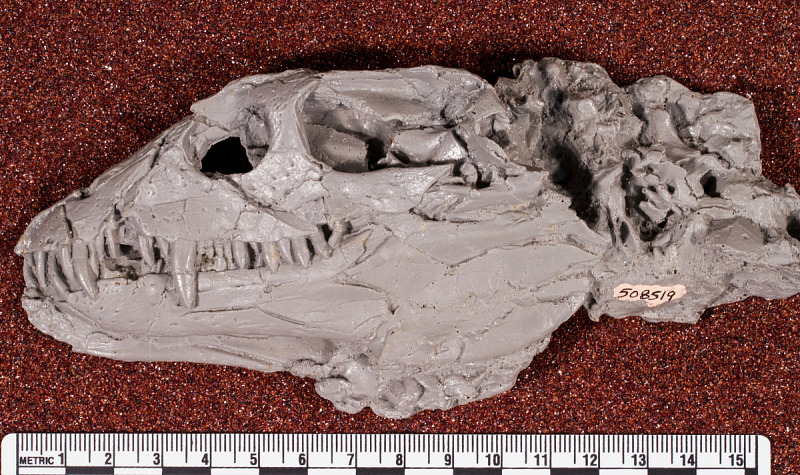
Armored aquatic reptile — Vancleavea campi
Geologic period: Late Triassic — Rhaetian for the Smithsonian specimen
Age: Late Triassic.
Feeding: Predatory aquatic feeding is inferred from skull and tooth anatomy.
Locomotion: Semiaquatic locomotion, with the tail playing an important role in movement through water.
Body plan: Long-bodied reptile with small limbs, a deep tail and multiple distinctive forms of overlapping osteoderms.
Evidence: Nearly complete skeletons preserve body armor, skull, small limbs and tail anatomy consistent with semiaquatic specialization.
Why it matters: Vancleavea reveals just how experimental archosauriform evolution became during the Triassic. Its body form has no close modern equivalent.
Plain Language Identity: A bizarre armored Late Triassic archosauriform with strong adaptations for a semiaquatic lifestyle.
What You Are Looking At: A cast based on fossil skeletal material of Vancleavea campi.
Defense Or Attack: Extensive body armor consisted of overlapping osteoderms.
Ecosystem: Late Triassic river and floodplain systems of western North America.
Preservation: Visitor object is a cast based on fossil material.
Formation: Chinle Formation for the Smithsonian specimen.
Find Location: New Mexico, United States, for the Smithsonian specimen.
Research History: Phylogenetic studies place Vancleavea outside crown Archosauria but within Archosauriformes.
Open Questions: Do not call Vancleavea a crocodilian or dinosaur. Its placement is on a separate stem-archosauriform branch.
Source Urls: https://naturalhistory.si.edu/visit/virtual-tour/current-exhibits/deep-time-virtual-tour-fossil-list; https://www.si.edu/object/nmnhpaleobiology_12307215; https://doi.org/10.1111/j.1096-3642.2009.00530.x
Enrichment Method: SAGE curated research pass; title and scientific name matched; chronology and lineage distinctions retained; evidence separated from inference
Scientific name: Vancleavea campi
Evidence / representation: comparative_taxon_visual
comparative_taxon_visual
Rise of the Dinosaurs: A New World After Catastrophe.
Media license: CC BY-SA 4.0
https://creativecommons.org/licenses/by-sa/4.0
This object page stays inside SAGE Museum. The Smithsonian link below is provided only as the original scholarly collection record. It opens separately.
VIEW ORIGINAL SMITHSONIAN RECORD ↗