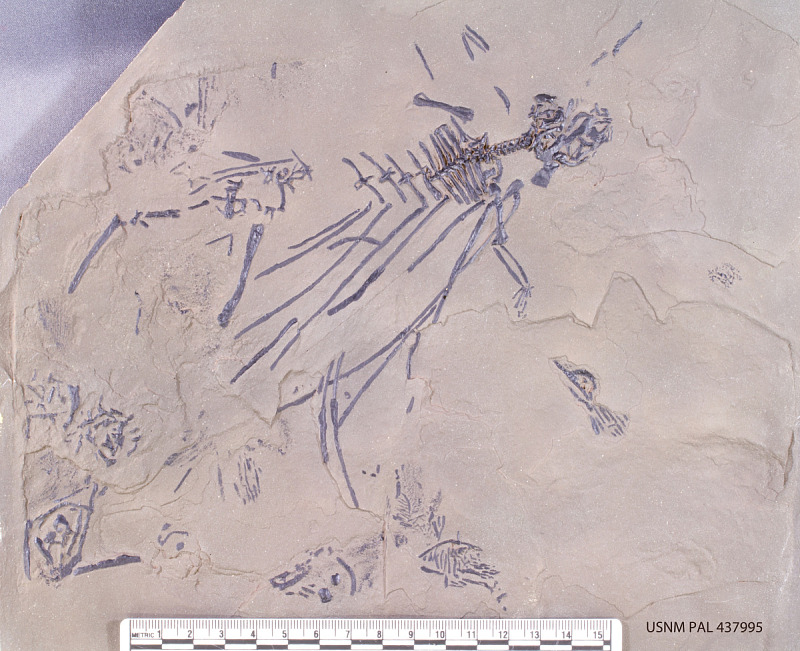
Gliding reptile — Icarosaurus siefkeri
Geologic period: Late Triassic
Age: Late Triassic.
Feeding: Diet is not securely established from the display cast.
Locomotion: Terrestrial movement combined with aerial gliding.
Body plan: Small terrestrial reptile with dramatically elongated ribs that supported lateral gliding membranes.
Evidence: Elongated ribs are directly preserved and form the structural basis for reconstruction of a gliding membrane.
Why it matters: Icarosaurus demonstrates that vertebrates repeatedly evolved gliding independently, using anatomical solutions very different from true powered flight.
Discovery context: The original Icarosaurus fossil was discovered in 1960 by teenager Alfred Siefker and described scientifically in the 1960s.
Plain Language Identity: A small Late Triassic kuehneosaurid reptile that glided using membranes supported by greatly elongated ribs.
What You Are Looking At: A cast representing the skeleton of Icarosaurus siefkeri.
Ecosystem: Late Triassic terrestrial environment of eastern North America.
Preservation: Visitor object is a skeleton cast.
Formation: Lockatong Formation.
Find Location: Bergen County, New Jersey, United States.
Open Questions: Do not call Icarosaurus a pterosaur. It glided rather than evolving the powered-flight system of pterosaurs.
Source Urls: https://naturalhistory.si.edu/visit/virtual-tour/current-exhibits/deep-time-virtual-tour-fossil-list; https://www.si.edu/object/icarosaurus-siefkeri-colbert-1966:nmnhpaleobiology_3427354; https://field.biodiversitylibrary.org/bibliography/207189
Enrichment Method: SAGE curated research pass; title and scientific name matched; chronology and lineage distinctions retained; evidence separated from inference
Scientific name: Icarosaurus siefkeri
Evidence / representation: comparative_taxon_visual
comparative_taxon_visual
Rise of the Dinosaurs: A New World After Catastrophe.
Media license: CC BY-SA 4.0
https://creativecommons.org/licenses/by-sa/4.0
This object page stays inside SAGE Museum. The Smithsonian link below is provided only as the original scholarly collection record. It opens separately.
VIEW ORIGINAL SMITHSONIAN RECORD ↗