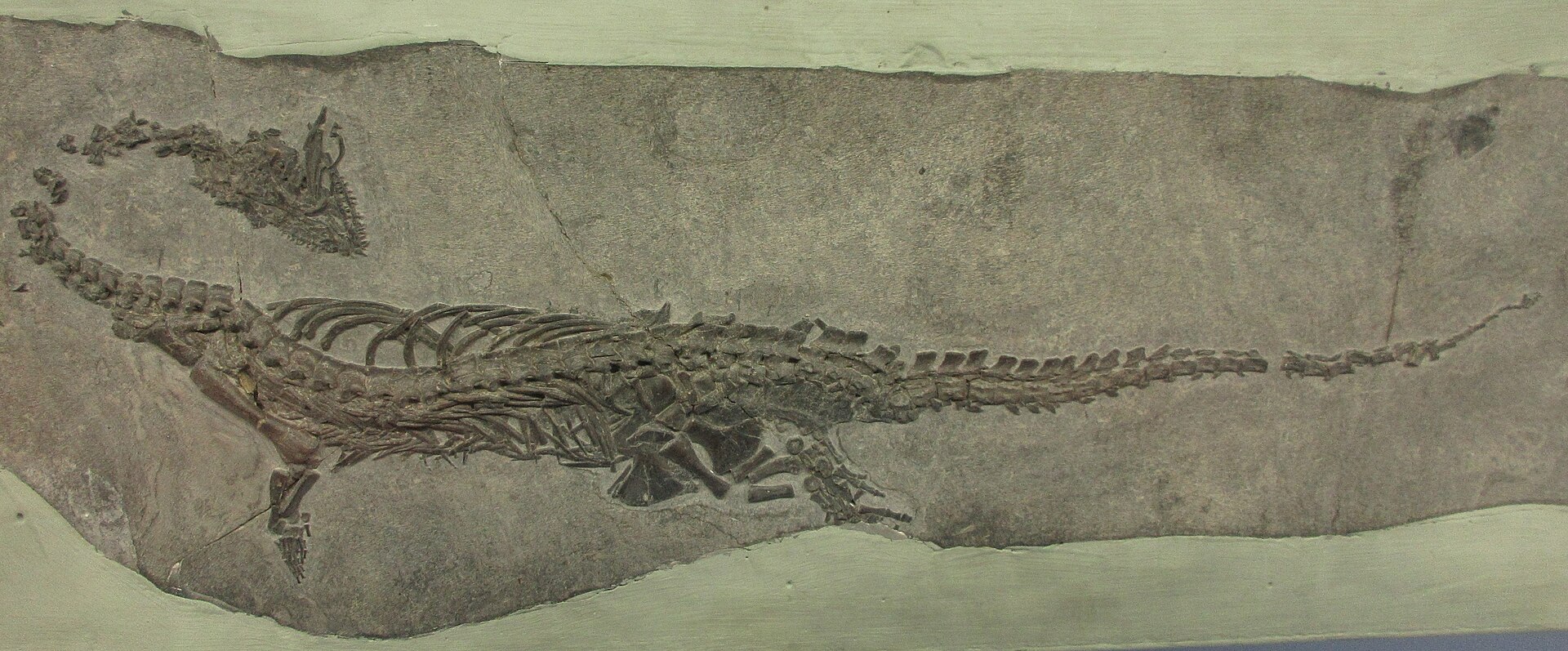
Nothosaur marine reptile — Neusticosaurus edwardsii
Geologic period: Middle Triassic — Ladinian
Age: Middle Triassic, Ladinian.
Feeding: Small aquatic prey is inferred from skull and tooth anatomy.
Locomotion: Aquatic swimming using body, tail and limbs.
Body plan: Small elongated sauropterygian with a long neck, slender limbs and an aquatic body form.
Evidence: Numerous skeletons preserve anatomy and growth information. Bone-growth rings have even been used to estimate maturity and lifespan in related Neusticosaurus samples.
Why it matters: Neusticosaurus demonstrates the diversity of small marine sauropterygians before the later rise of giant plesiosaurs.
Plain Language Identity: A small pachypleurosaur marine reptile from the Middle Triassic.
What You Are Looking At: Fossil skeletal material of Neusticosaurus edwardsii.
Ecosystem: Middle Triassic shallow marine environment around the Monte San Giorgio region.
Preservation: Fossil skeleton.
Find Location: Northern Italy / southern Switzerland region.
Open Questions: Do not describe this small pachypleurosaur as a plesiosaur. Both belong within Sauropterygia, but they are distinct groups.
Source Urls: https://naturalhistory.si.edu/visit/virtual-tour/current-exhibits/deep-time-virtual-tour-fossil-list; https://pubmed.ncbi.nlm.nih.gov/2575768/; https://pmc.ncbi.nlm.nih.gov/articles/PMC9276568/
Enrichment Method: SAGE curated research pass; title and scientific name matched; chronology and lineage distinctions retained; evidence separated from inference
Scientific name: Neusticosaurus edwardsii
Evidence / representation: comparative_taxon_visual
comparative_taxon_visual
Rise of the Dinosaurs: A New World After Catastrophe.
Media license: CC BY-SA 3.0 de
https://creativecommons.org/licenses/by-sa/3.0/de/deed.en
This object page stays inside SAGE Museum. The Smithsonian link below is provided only as the original scholarly collection record. It opens separately.
VIEW ORIGINAL SMITHSONIAN RECORD ↗