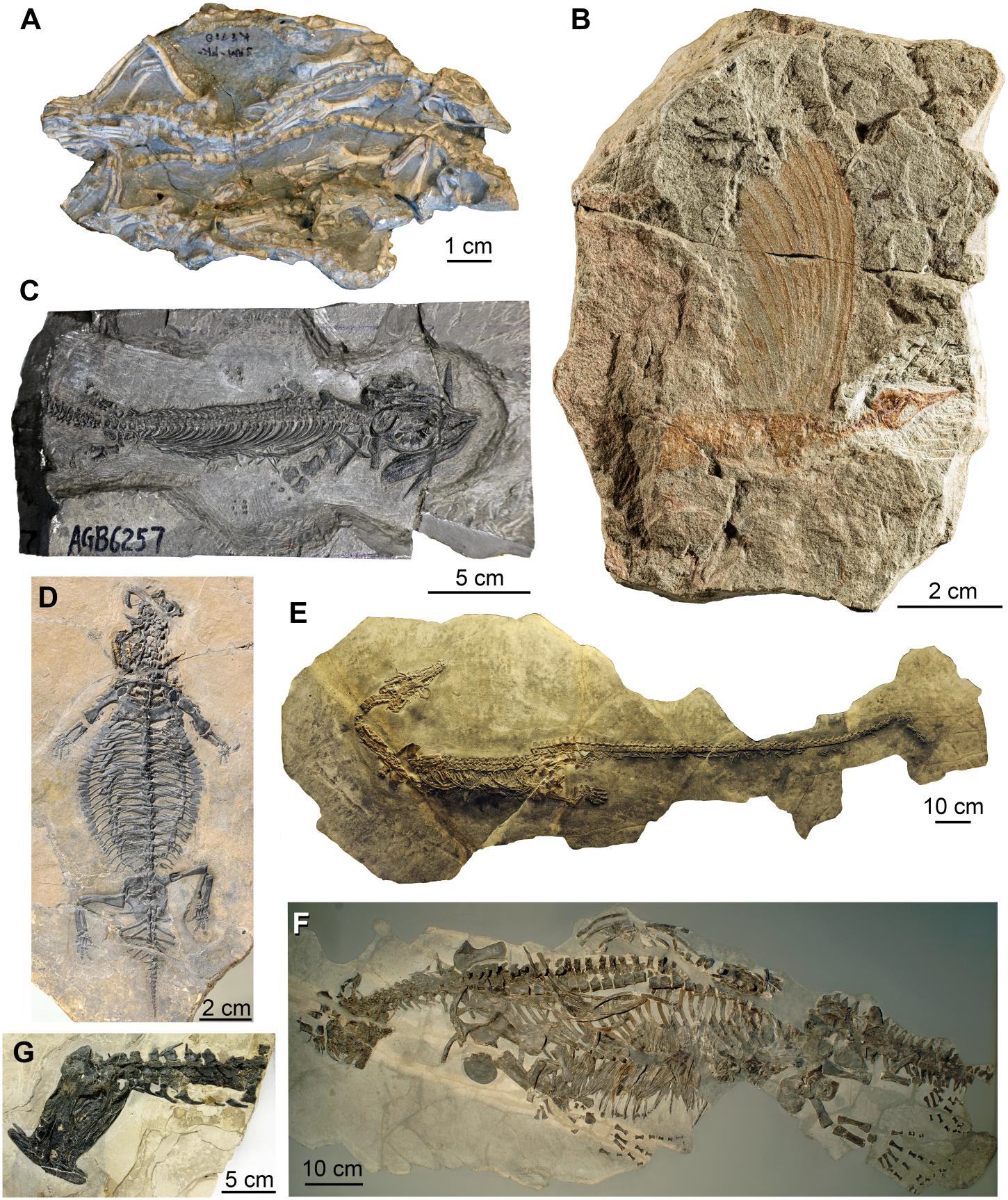
Thalattosaur marine reptile — Askeptosaurus italicus
Geologic period: Middle Triassic — late Anisian
Age: Middle Triassic.
Feeding: Predatory marine feeding is inferred from skull and teeth.
Locomotion: Aquatic swimming.
Body plan: Long slender body, elongated neck and tail, with limbs retained for swimming and maneuvering.
Evidence: Skeletons preserve direct anatomical evidence. Bone histology shows unusually compact internal bone structure.
Why it matters: Askeptosaurus represents one of several entirely different reptile lineages that independently invaded Triassic seas.
Plain Language Identity: A long-bodied Middle Triassic thalattosaur adapted for life in marine environments.
What You Are Looking At: A cast based on fossil skeletal material of Askeptosaurus italicus.
Ecosystem: Middle Triassic marine environment of the southern Alpine region.
Preservation: Visitor display is a cast.
Find Location: Southern Alpine region, including material from Italy and Switzerland.
Open Questions: Do not group thalattosaurs with ichthyosaurs, plesiosaurs or mosasaurs simply because all were marine reptiles.
Source Urls: https://naturalhistory.si.edu/visit/virtual-tour/current-exhibits/deep-time-virtual-tour-fossil-list; https://pubmed.ncbi.nlm.nih.gov/37601161/; https://pmc.ncbi.nlm.nih.gov/articles/PMC10432342/
Enrichment Method: SAGE curated research pass; title and scientific name matched; chronology and lineage distinctions retained; evidence separated from inference
Scientific name: Askeptosaurus italicus
Evidence / representation: comparative_taxon_visual
comparative_taxon_visual
Rise of the Dinosaurs: A New World After Catastrophe.
Media license: CC BY 4.0
https://creativecommons.org/licenses/by/4.0
This object page stays inside SAGE Museum. The Smithsonian link below is provided only as the original scholarly collection record. It opens separately.
VIEW ORIGINAL SMITHSONIAN RECORD ↗