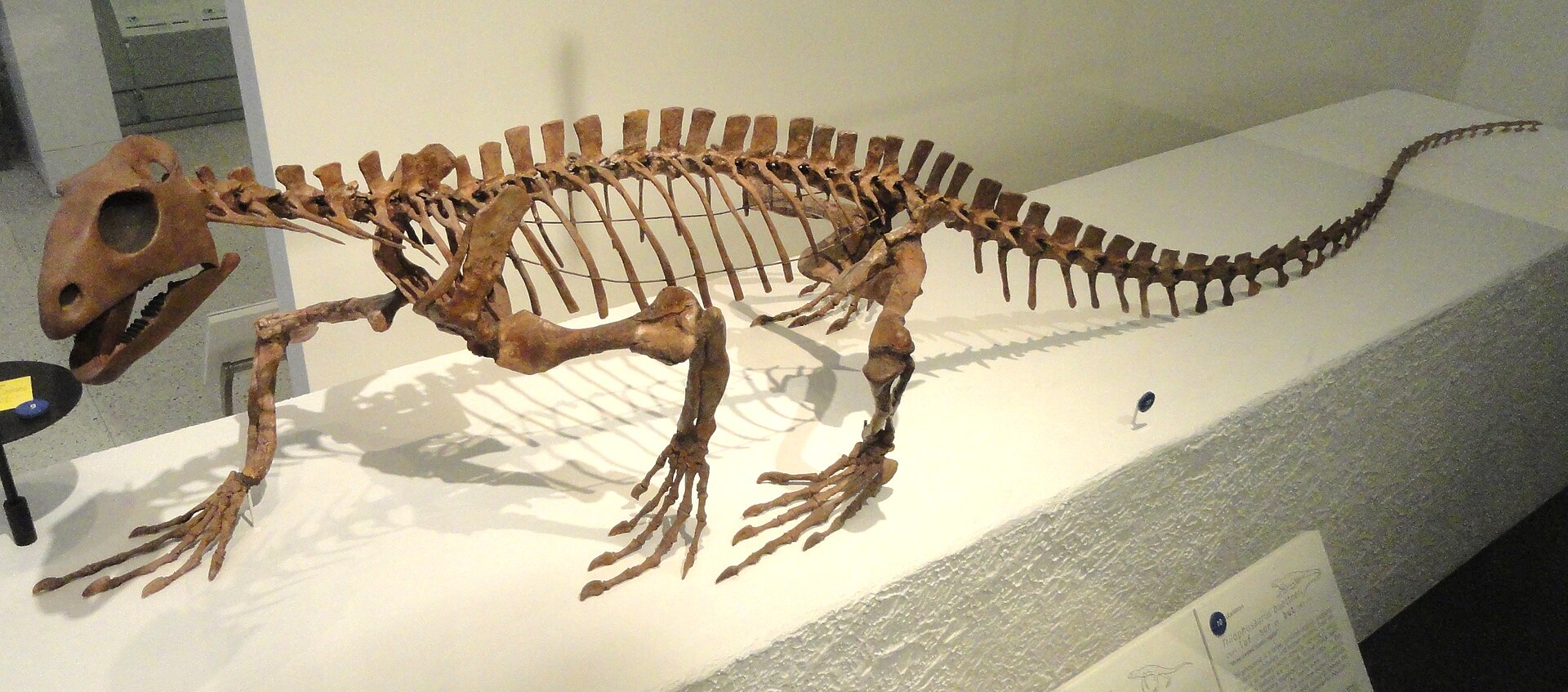
Herbivorous reptile — Trilophosaurus buettneri
Geologic period: Late Triassic — Norian to possibly Rhaetian
Age: Late Triassic.
Feeding: Primarily herbivorous. Broad multi-cusped teeth and strong jaw musculature were suited to processing tough vegetation.
Locomotion: Terrestrial quadruped; some skeletal features have been interpreted as compatible with climbing ability.
Body plan: Robust archosauromorph with a deep skull, strong jaws and distinctive transversely broad teeth.
Evidence: Skull structure and tooth morphology are direct evidence. Diet is strongly inferred from dental form and functional studies.
Why it matters: Trilophosaurus demonstrates that Triassic herbivores experimented with specialized feeding systems very different from those of later dinosaur herbivores.
Plain Language Identity: A specialized Late Triassic trilophosaurid archosauromorph with broad multi-cusped teeth.
What You Are Looking At: A composite skeletal display representing Trilophosaurus buettneri.
Ecosystem: Late Triassic terrestrial ecosystems of the American Southwest.
Preservation: Composite museum mount.
Find Location: Smithsonian material includes fossils from Texas.
Open Questions: Potential climbing or arboreal behavior should remain an anatomical hypothesis rather than a certainty.
Source Urls: https://naturalhistory.si.edu/visit/virtual-tour/current-exhibits/deep-time-virtual-tour-fossil-list; https://www.si.edu/object/trilophosaurus-buettneri-case-1928:nmnhpaleobiology_3448971; https://pmc.ncbi.nlm.nih.gov/articles/PMC10031418/
Enrichment Method: SAGE curated research pass; title and scientific name matched; chronology and lineage distinctions retained; evidence separated from inference
Scientific name: Trilophosaurus buettneri
Evidence / representation: comparative_taxon_visual
comparative_taxon_visual
Rise of the Dinosaurs: A New World After Catastrophe.
Media license: CC0
http://creativecommons.org/publicdomain/zero/1.0/deed.en
This object page stays inside SAGE Museum. The Smithsonian link below is provided only as the original scholarly collection record. It opens separately.
VIEW ORIGINAL SMITHSONIAN RECORD ↗