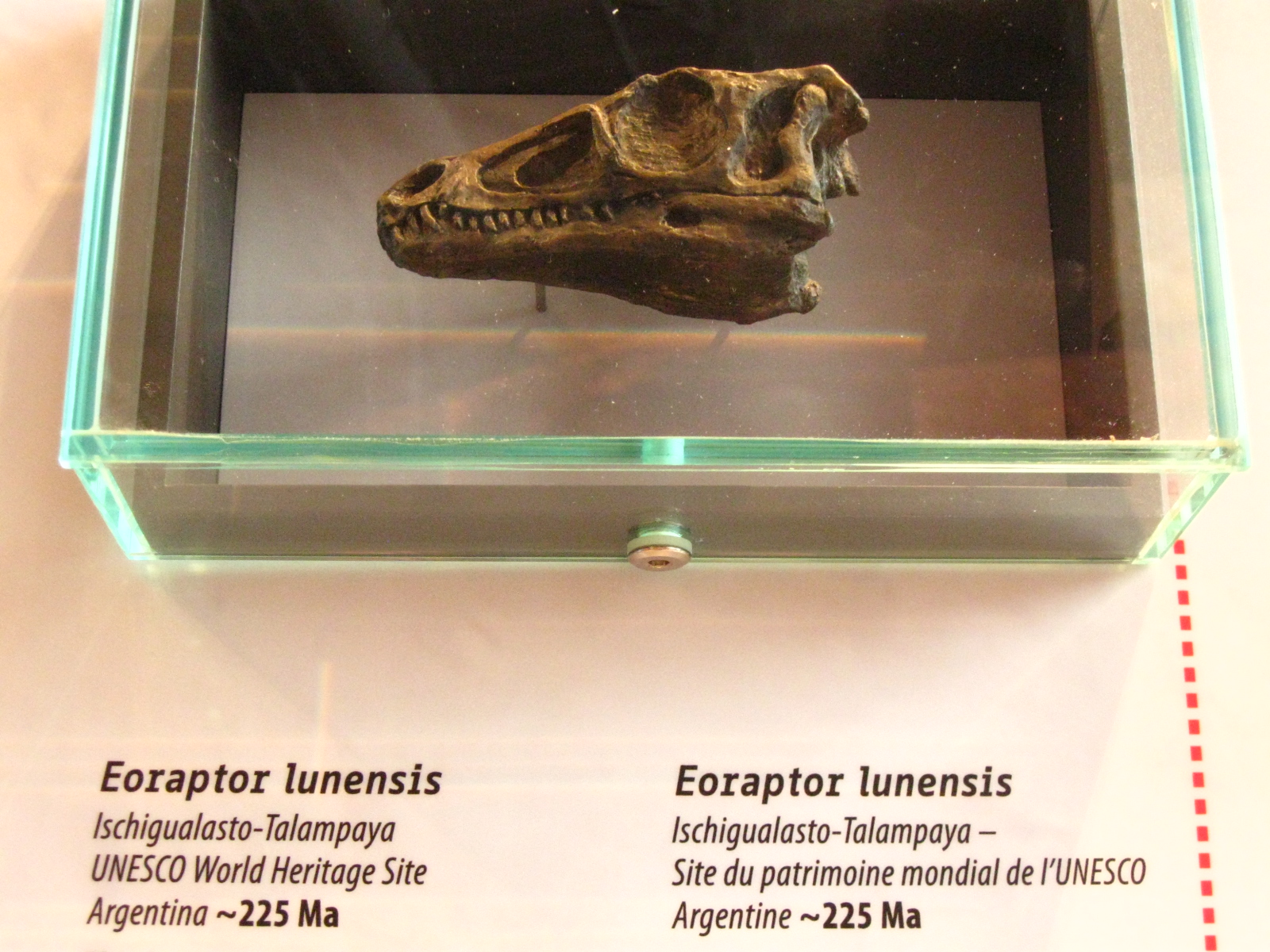
Early dinosaur — Eoraptor lunensis
Geologic period: Late Triassic — Carnian
Age: Approximately 232 to 231 million years ago according to the Smithsonian Deep Time interpretation.
Feeding: Smithsonian interprets Eoraptor as omnivorous. Its teeth include features consistent with a mixed diet.
Locomotion: Bipedal terrestrial locomotion.
Body plan: Lightly built bipedal dinosaur with a small skull, grasping forelimbs and relatively long hind limbs.
Evidence: Nearly complete skeletal material provides unusually detailed anatomical evidence for such an early dinosaur.
Why it matters: Eoraptor helps document the first major diversification of dinosaurs before they became dominant terrestrial animals.
Plain Language Identity: One of the earliest well-known dinosaurs, a small bipedal saurischian from Late Triassic Argentina.
What You Are Looking At: A skeletal cast based on fossils of Eoraptor lunensis.
Ecosystem: Ischigualasto Formation ecosystem of what is now Argentina.
Preservation: Visitor object is a cast based on fossil skeletal material.
Find Location: San Juan Province, Argentina.
Formation: Ischigualasto Formation.
Research History: Eoraptor was originally interpreted as an early theropod. Detailed later studies recovered it as an early sauropodomorph, and its placement has played an important role in debates over early dinosaur relationships.
Open Questions: Present Eoraptor securely as an early dinosaur while acknowledging the history of debate over its precise position within Saurischia.
Source Urls: https://naturalhistory.si.edu/visit/virtual-tour/current-exhibits/deep-time-virtual-tour-fossil-list; https://www.si.edu/newsdesk/factsheets/david-h-koch-hall-fossils-deep-time; https://doi.org/10.1080/02724634.2013.820113; https://doi.org/10.1080/14772019.2024.2345333
Enrichment Method: SAGE curated research pass; title and scientific name matched; chronology and lineage distinctions retained; evidence separated from inference
Scientific name: Eoraptor lunensis
Evidence / representation: comparative_taxon_visual
comparative_taxon_visual
Rise of the Dinosaurs: A New World After Catastrophe.
Media license: CC BY 2.0
https://creativecommons.org/licenses/by/2.0
This object page stays inside SAGE Museum. The Smithsonian link below is provided only as the original scholarly collection record. It opens separately.
VIEW ORIGINAL SMITHSONIAN RECORD ↗