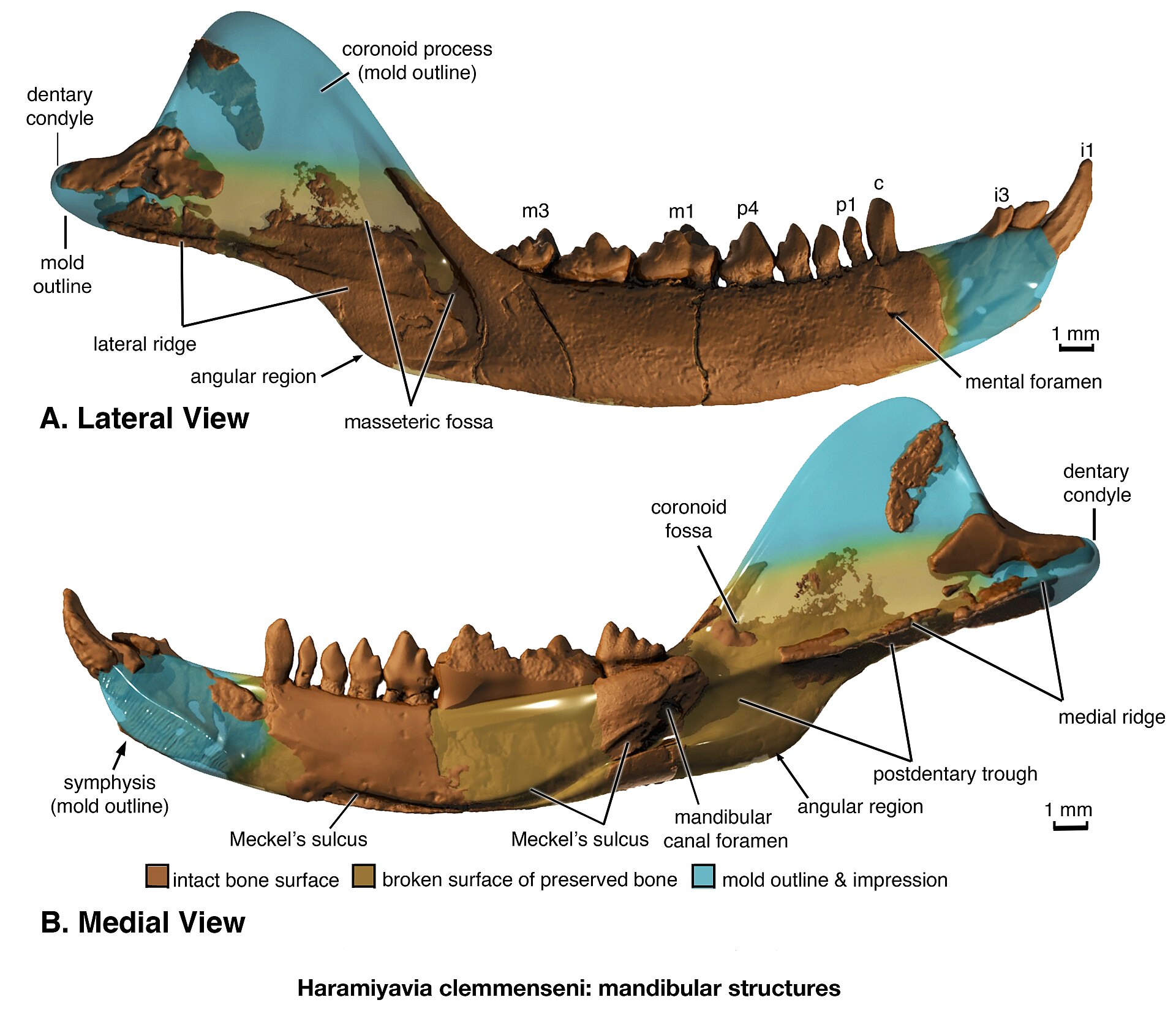
Early mammal or mammal relative — Haramiyavia clemmenseni
Geologic period: Late Triassic — Rhaetian
Age: Early Rhaetian, Late Triassic.
Feeding: Tooth wear and occlusion indicate an omnivorous or herbivorous feeding adaptation.
Locomotion: Not directly established by the jaw casts.
Body plan: Small mammaliaform known especially from jaws, teeth and associated skeletal material.
Evidence: Jaw anatomy, tooth structure, wear facets and CT-based reconstruction of occlusion provide direct and analytical evidence for its feeding system.
Why it matters: Haramiyavia preserves a transitional combination of mammaliaform jaw and dental features and helps scientists study the evolutionary experiments occurring near the origin of mammals.
Plain Language Identity: A Late Triassic haramiyidan mammaliaform from East Greenland, close to the evolutionary origin of mammals but not necessarily inside crown Mammalia.
What You Are Looking At: Casts representing jaw material and complex multi-cusped teeth of Haramiyavia clemmenseni.
Ecosystem: Late Triassic terrestrial ecosystem of East Greenland.
Preservation: Visitor display uses jaw casts based on fossil material.
Find Location: East Greenland.
Formation: Fleming Fjord Formation, Tait Bjerg Beds.
Research History: Haramiyid relationships have been debated. Detailed studies of Haramiyavia have supported placement among stem mammaliaforms outside crown Mammalia, while other analyses of haramiyidans have produced competing results.
Open Questions: Do not call Haramiyavia a modern-style mammal or imply that its exact position on the mammal family tree is universally settled.
Source Urls: https://naturalhistory.si.edu/visit/virtual-tour/current-exhibits/deep-time-virtual-tour-fossil-list; https://pmc.ncbi.nlm.nih.gov/articles/PMC4697399/; https://pmc.ncbi.nlm.nih.gov/articles/PMC7604429/
Enrichment Method: SAGE curated research pass; title and scientific name matched; chronology and lineage distinctions retained; evidence separated from inference
Scientific name: Haramiyavia clemmenseni
Evidence / representation: comparative_taxon_visual
comparative_taxon_visual
Rise of the Dinosaurs: A New World After Catastrophe.
Media license: CC BY 4.0
https://creativecommons.org/licenses/by/4.0
This object page stays inside SAGE Museum. The Smithsonian link below is provided only as the original scholarly collection record. It opens separately.
VIEW ORIGINAL SMITHSONIAN RECORD ↗