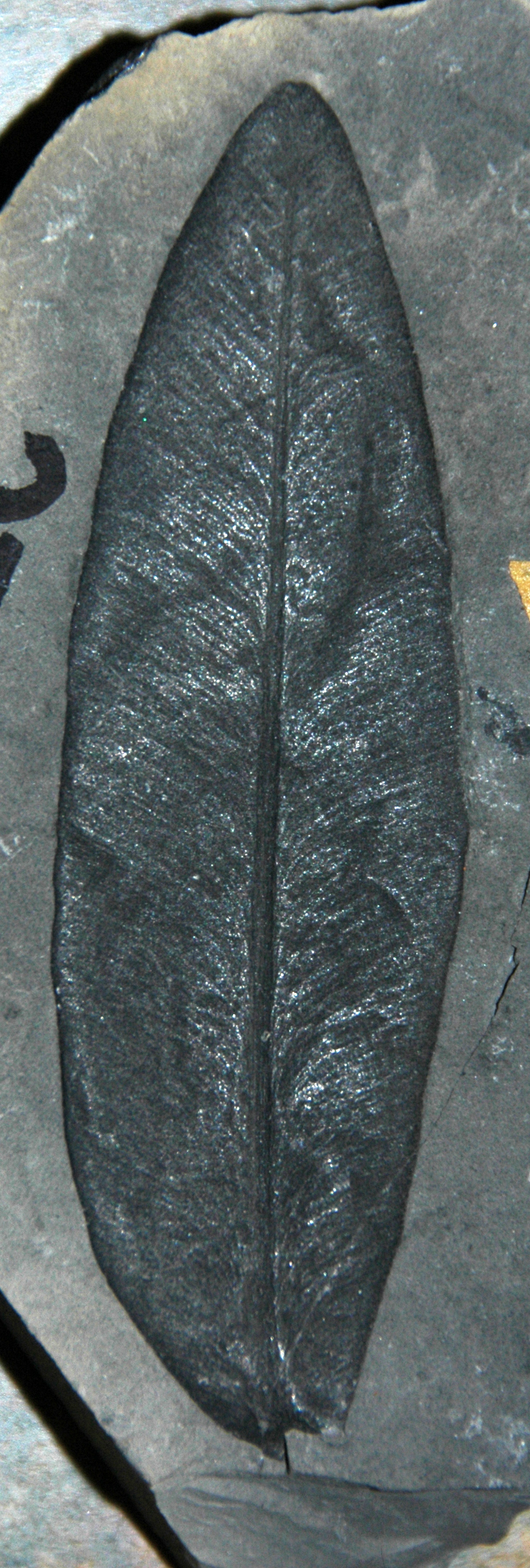
Seed plant — Glossopteris sp.
Geologic period: Permian
Age: Permian. Glossopteris fossils from Gondwana span much of the period; this genus-level exhibit specimen is not given a more precise age here.
Feeding: Photosynthetic plant.
Body plan: Woody seed plant reconstructed from leaves, stems, roots and reproductive organs preserved separately.
Evidence: Leaves and other plant organs are direct fossils. Continental connection is inferred from geology, fossil distribution and plate-tectonic evidence.
Why it matters: Glossopteris is important both biologically and geologically. Its widespread fossils across now-separated southern continents became famous evidence that those lands were once connected within Gondwana.
Plain Language Identity: A member of the extinct Glossopteris seed-plant flora that dominated large parts of the southern supercontinent Gondwana during the Permian.
What You Are Looking At: Fossil leaves with the characteristic tongue-shaped Glossopteris form and branching, interconnected veins.
Ecosystem: Permian Gondwanan terrestrial forests.
Preservation: Leaf compression or impression.
Research History: Glossopteris fossils occur across South America, Africa, India, Australia and Antarctica. Antarctic specimens were among the historically important discoveries supporting the reconstruction of Gondwana.
Open Questions: The Smithsonian object is Glossopteris sp.; do not assign a species unless its individual catalog record supports it.
Source Urls: https://naturalhistory.si.edu/visit/virtual-tour/current-exhibits/deep-time-virtual-tour-fossil-list; https://www.si.edu/object/nmnhpaleobiology_3328030; https://www.antarctica.gov.au/about-antarctica/geography-and-geology/geology/antarctic-prehistory/
Enrichment Method: SAGE curated research pass; title and scientific name matched; current research distinctions retained; evidence separated from inference
Scientific name: Glossopteris sp.
Evidence / representation: comparative_taxon_visual
comparative_taxon_visual
The Permian World: Strange Bodies and the Great Dying.
Media license: CC BY 2.0
https://creativecommons.org/licenses/by/2.0
This object page stays inside SAGE Museum. The Smithsonian link below is provided only as the original scholarly collection record. It opens separately.
VIEW ORIGINAL SMITHSONIAN RECORD ↗