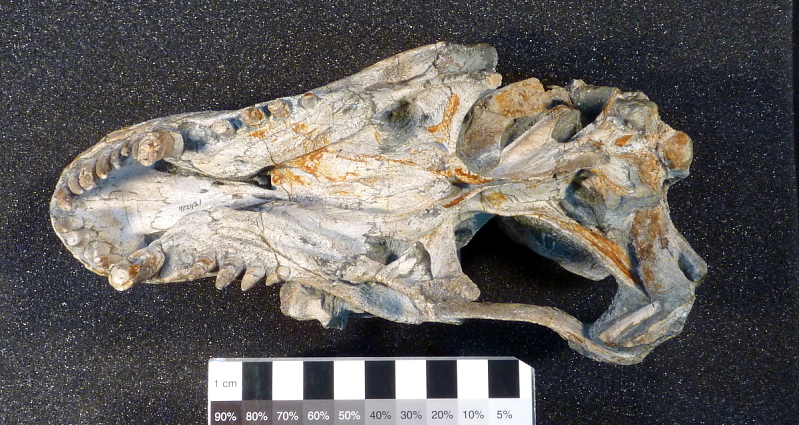
Therocephalian synapsid — Proalopecopsis haughtoni
Geologic period: Late Permian
Age: Late Permian.
Feeding: Carnivorous or strongly faunivorous feeding is inferred from its therocephalian skull and dentition.
Locomotion: Terrestrial quadruped.
Body plan: Terrestrial therapsid with differentiated incisors, canines and postcanine teeth.
Evidence: Cranium and teeth are directly preserved. Detailed behavior is reconstructed from the functional anatomy.
Why it matters: Proalopecopsis adds another branch of predatory therapsids to the Permian story and helps show how diverse the synapsid radiation became before the Great Dying.
Plain Language Identity: A Late Permian therocephalian therapsid from South Africa.
What You Are Looking At: A partial fossil skull preserving numerous teeth. The Smithsonian also preserves associated ribs and a limb element from the specimen.
Defense Or Attack: The differentiated teeth, including prominent canines, formed the primary prey-processing apparatus.
Ecosystem: Late Permian terrestrial ecosystem of South Africa.
Preservation: Partial skull with associated skeletal material.
Formation: Teekloof Formation.
Find Location: South Africa.
Open Questions: Do not reconstruct hunting behavior more specifically than the anatomy supports.
Source Urls: https://naturalhistory.si.edu/visit/virtual-tour/current-exhibits/deep-time-virtual-tour-fossil-list; https://www.si.edu/es/object/3d/proalopecopsis-haughtoni-brink-kitching-1951:7f87a348-923f-4f4c-8b99-8754ee39196a; https://3d.si.edu/object/3d/proalopecopsis-haughtoni-brink-kitching-1951:7f87a348-923f-4f4c-8b99-8754ee39196a
Enrichment Method: SAGE curated research pass; title and scientific name matched; current research distinctions retained; evidence separated from inference
Scientific name: Proalopecopsis haughtoni
Evidence / representation: comparative_taxon_visual
comparative_taxon_visual
The Permian World: Strange Bodies and the Great Dying.
Media license: CC0
http://creativecommons.org/publicdomain/zero/1.0/deed.en
This object page stays inside SAGE Museum. The Smithsonian link below is provided only as the original scholarly collection record. It opens separately.
VIEW ORIGINAL SMITHSONIAN RECORD ↗