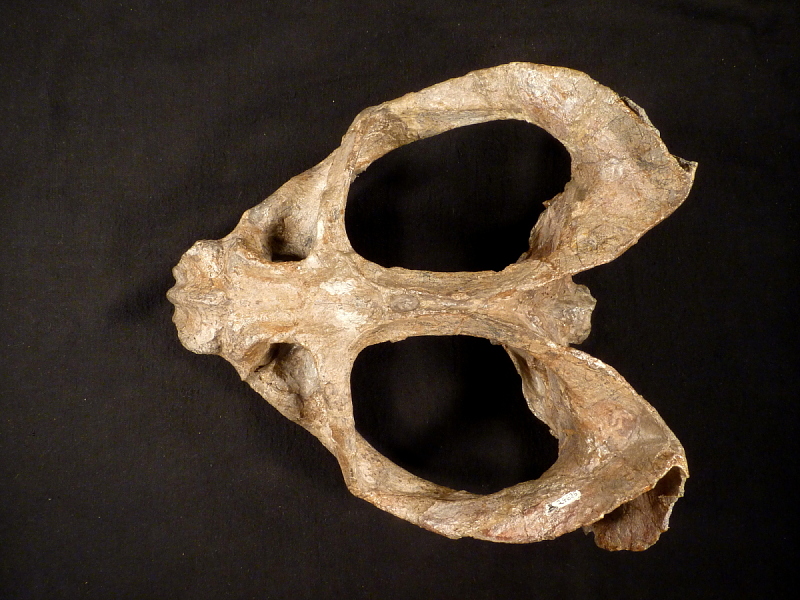
Dicynodont synapsid — Oudenodon bainii
Geologic period: Late Permian
Age: Late Permian; Smithsonian material includes specimens from the Cistecephalus assemblage-zone interval.
Feeding: Herbivorous.
Locomotion: Terrestrial quadruped.
Body plan: Robust terrestrial dicynodont with a short skull and a beak-like feeding apparatus.
Evidence: Skull form is direct evidence. Its tuskless condition is important in distinguishing it from some similar dicynodont taxa.
Why it matters: Oudenodon shows the extraordinary success and diversity of herbivorous dicynodont therapsids before the end-Permian extinction.
Plain Language Identity: A Late Permian tuskless dicynodont therapsid.
What You Are Looking At: A fossil skull of Oudenodon bainii.
Ecosystem: Late Permian terrestrial ecosystems of southern Africa.
Preservation: Fossil skull.
Formation: Beaufort Group for Smithsonian material.
Find Location: South Africa.
Research History: Oudenodon bainii has historically been difficult to separate from the very similar Tropidostoma microtrema. Morphometric and stratigraphic work supports treating them as separate species.
Open Questions: Taxonomic identification should rely on multiple cranial features rather than tusks alone.
Source Urls: https://naturalhistory.si.edu/visit/virtual-tour/current-exhibits/deep-time-virtual-tour-fossil-list; https://www.si.edu/object/nmnhpaleobiology_3450217; https://doi.org/10.1111/j.1475-4983.2007.00697.x
Enrichment Method: SAGE curated research pass; title and scientific name matched; current research distinctions retained; evidence separated from inference
Scientific name: Oudenodon bainii
Evidence / representation: comparative_taxon_visual
comparative_taxon_visual
The Permian World: Strange Bodies and the Great Dying.
Media license: CC0
http://creativecommons.org/publicdomain/zero/1.0/deed.en
This object page stays inside SAGE Museum. The Smithsonian link below is provided only as the original scholarly collection record. It opens separately.
VIEW ORIGINAL SMITHSONIAN RECORD ↗