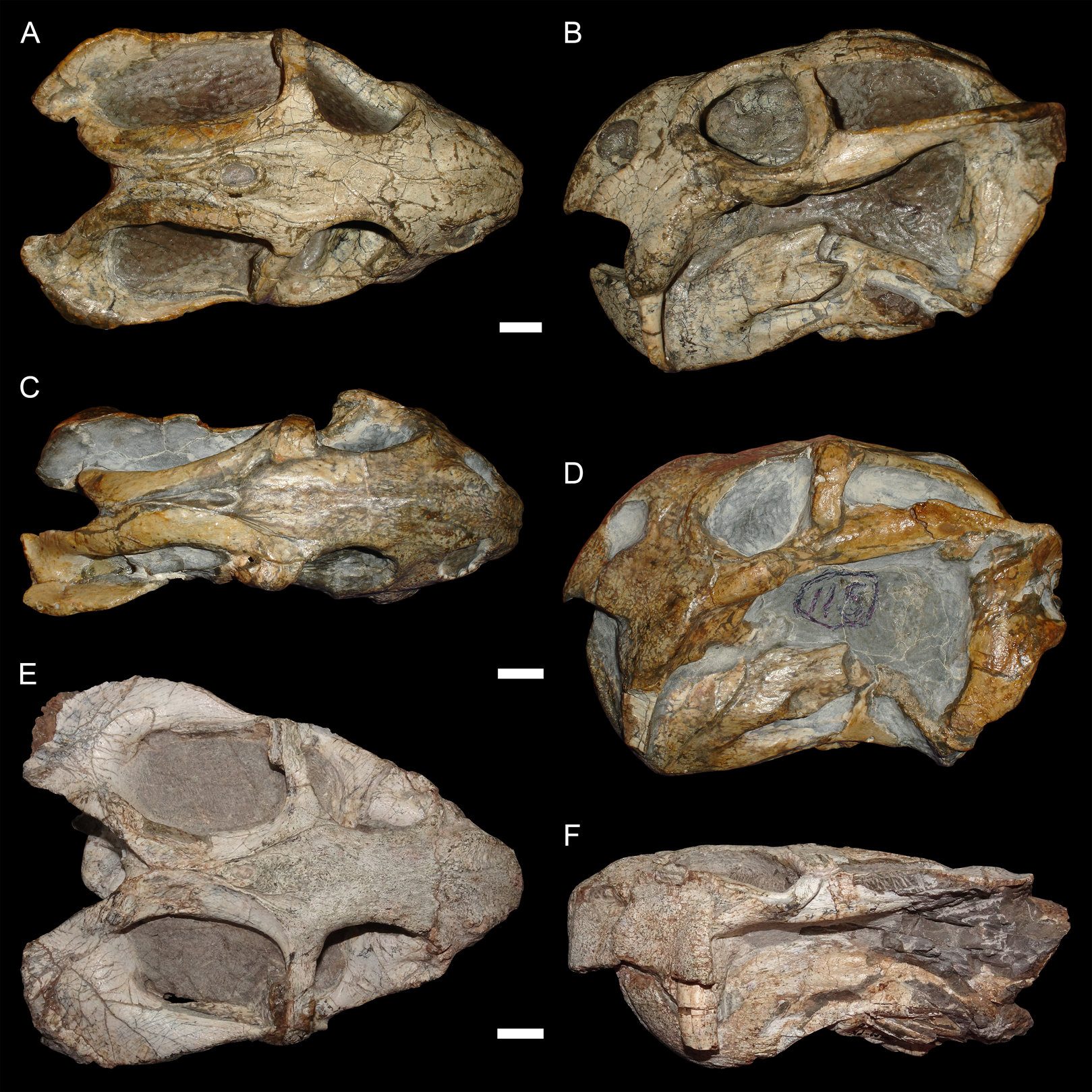
Dicynodont synapsid — Diictodon feliceps
Geologic period: Late Permian
Age: Late Permian.
Feeding: Herbivorous.
Locomotion: Terrestrial quadruped capable of digging.
Body plan: Small, sturdy quadrupedal dicynodont with a short skull and keratinous-beak region.
Evidence: Skulls and skeletons are direct evidence. Burrow casts containing articulated Diictodon skeletons strongly support active burrowing.
Why it matters: Diictodon gives unusually strong evidence for behavior because articulated animals have been found inside fossil burrows.
Discovery context: Some Late Permian burrows contain adult and neonatal Diictodon remains, raising the possibility that burrows also served reproductive or nursery functions.
Plain Language Identity: A small Late Permian dicynodont therapsid and one of the best-known burrowing synapsids of the Karoo Basin.
What You Are Looking At: A fossil skull of Diictodon feliceps.
Ecosystem: Late Permian floodplain environments of southern Africa.
Preservation: Fossil skull.
Find Location: South Africa for the Smithsonian material.
Open Questions: Burrowing is strongly supported. More specific claims about parental care remain hypotheses rather than direct observations.
Source Urls: https://naturalhistory.si.edu/visit/virtual-tour/current-exhibits/deep-time-virtual-tour-fossil-list; https://www.si.edu/object/diictodon-feliceps-owen-1876:nmnhpaleobiology_3450109; https://doi.org/10.1016/j.palaeo.2021.110311; https://www.si.edu/es/object/3d/diictodon-feliceps-owen-1876-skull:3b3add34-8d97-4a66-96fa-4e2d343db77c
Enrichment Method: SAGE curated research pass; title and scientific name matched; current research distinctions retained; evidence separated from inference
Scientific name: Diictodon feliceps
Evidence / representation: comparative_taxon_visual
comparative_taxon_visual
The Permian World: Strange Bodies and the Great Dying.
Media license: CC BY 4.0
https://creativecommons.org/licenses/by/4.0
This object page stays inside SAGE Museum. The Smithsonian link below is provided only as the original scholarly collection record. It opens separately.
VIEW ORIGINAL SMITHSONIAN RECORD ↗