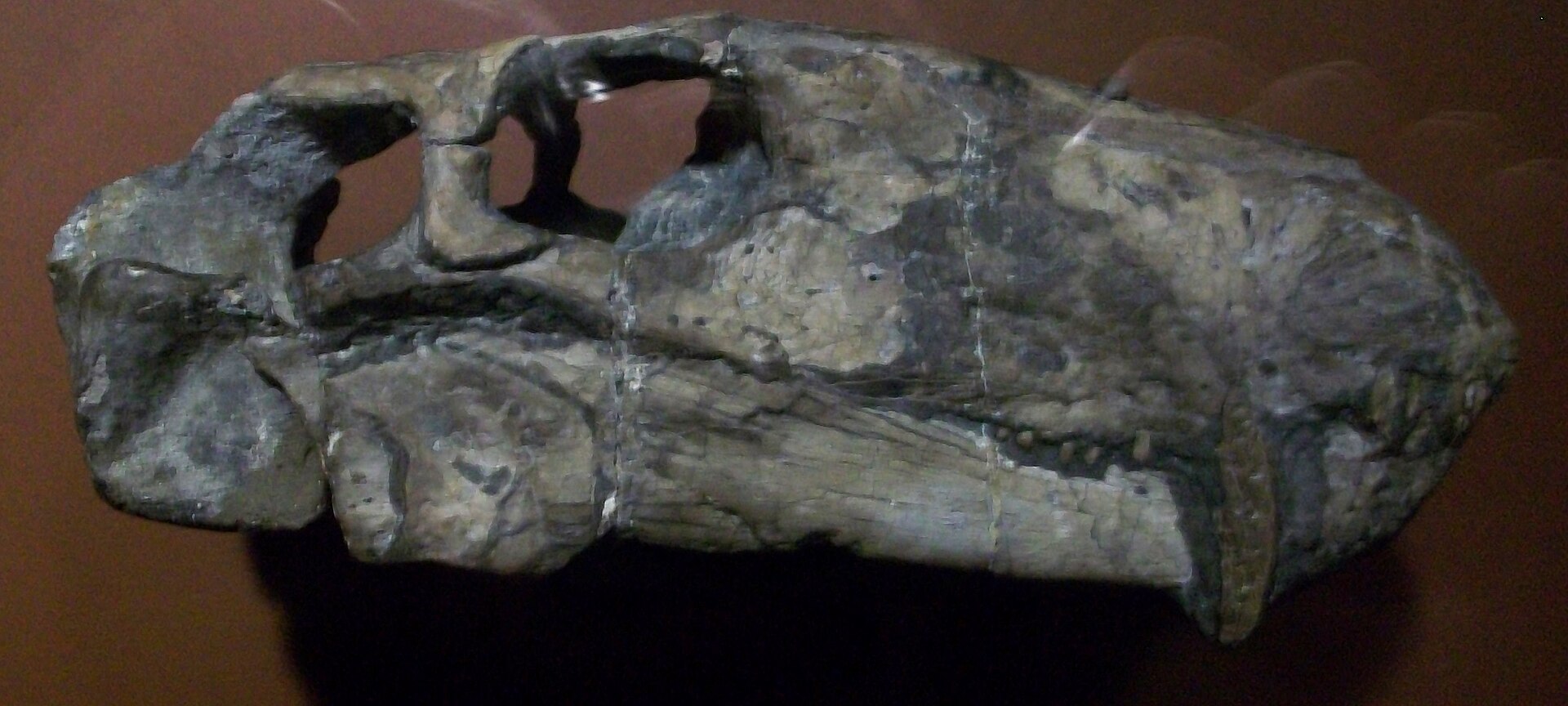
Gorgonopsian synapsid — Cyonosaurus longiceps
Geologic period: Late Permian
Age: Late Permian, Cistecephalus assemblage-zone context for the Smithsonian specimen.
Feeding: Carnivorous.
Locomotion: Terrestrial quadruped.
Body plan: Terrestrial predatory therapsid with an elongated skull and specialized carnivorous dentition.
Evidence: Cranial anatomy is directly preserved. Feeding behavior is inferred from gorgonopsian skull and dental anatomy.
Why it matters: Gorgonopsians show that formidable land predators already existed within the synapsid lineage tens of millions of years before large predatory dinosaurs.
Plain Language Identity: A Late Permian gorgonopsian, part of a lineage of predatory therapsid synapsids.
What You Are Looking At: A fossil cranium identified as Cyonosaurus longiceps.
Defense Or Attack: The skull and predatory dentition formed the main feeding and attack apparatus.
Ecosystem: Late Permian Karoo Basin ecosystem of South Africa.
Preservation: Fossil skull / cranium.
Formation: Teekloof Formation.
Find Location: South Africa.
Research History: Cyonosaurus taxonomy remains under study. Recent research notes that some named species may be difficult to separate because size and skull proportions can change during growth.
Open Questions: Retain the Smithsonian identification but do not imply that every historical Cyonosaurus species distinction is permanently settled.
Source Urls: https://naturalhistory.si.edu/visit/virtual-tour/current-exhibits/deep-time-virtual-tour-fossil-list; https://www.si.edu/object/nmnhpaleobiology_3450119; https://wiredspace.wits.ac.za/server/api/core/bitstreams/5d867beb-b755-43f0-8fef-0b04e0457524/content
Enrichment Method: SAGE curated research pass; title and scientific name matched; current research distinctions retained; evidence separated from inference
Scientific name: Cyonosaurus longiceps
Evidence / representation: comparative_taxon_visual
comparative_taxon_visual
The Permian World: Strange Bodies and the Great Dying.
Media license: CC BY-SA 3.0
https://creativecommons.org/licenses/by-sa/3.0
This object page stays inside SAGE Museum. The Smithsonian link below is provided only as the original scholarly collection record. It opens separately.
VIEW ORIGINAL SMITHSONIAN RECORD ↗