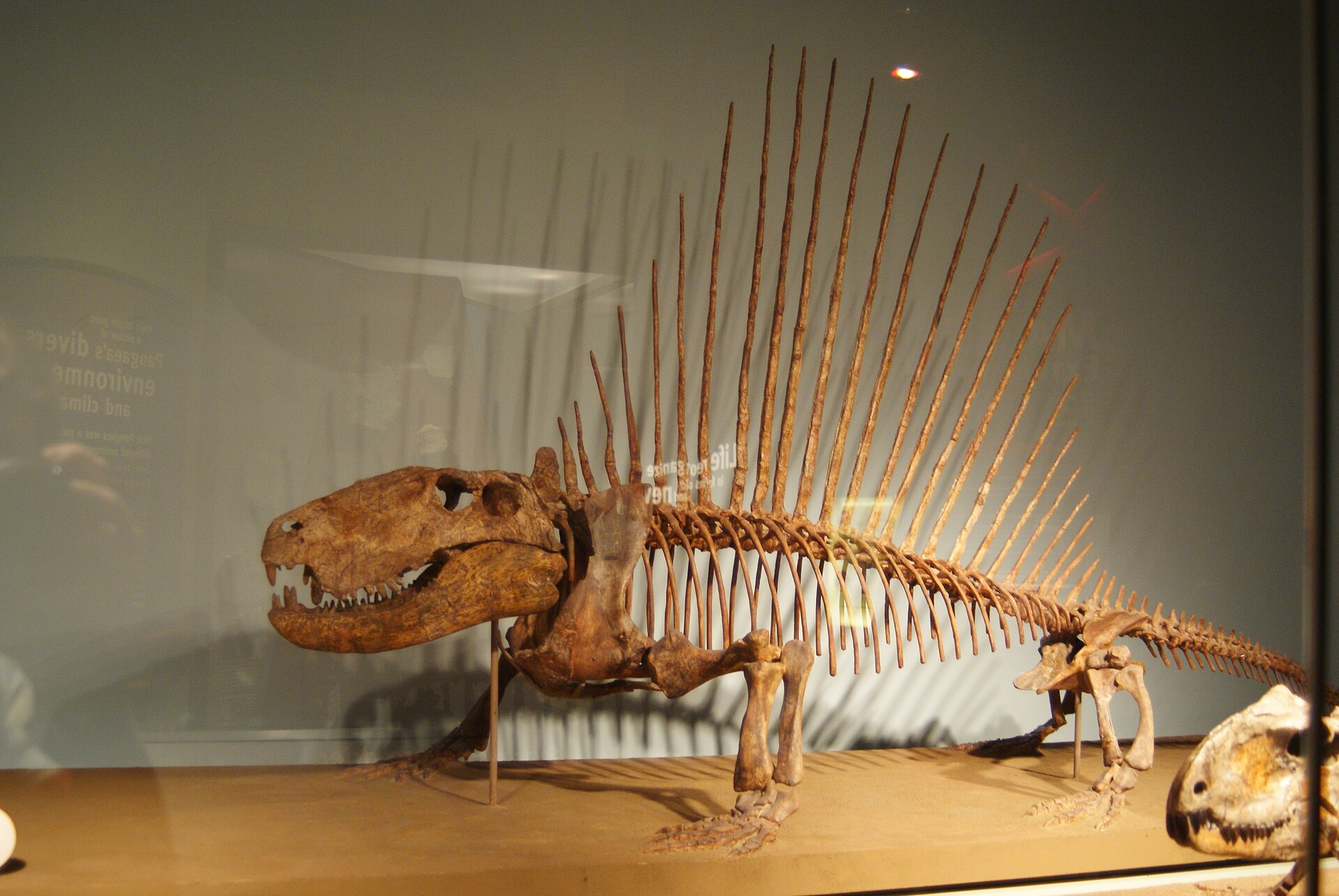
Early synapsid — Dimetrodon grandis
Geologic period: Early Permian
Age: Early Permian; Smithsonian specimens of Dimetrodon grandis come from Early Permian rocks of Texas.
Feeding: Predatory. Large serrated teeth and prominent canine-like teeth supported processing of vertebrate prey.
Locomotion: Terrestrial quadruped.
Body plan: Large quadrupedal synapsid with a deep skull, differentiated teeth and greatly elongated neural spines.
Evidence: Skull, teeth, vertebrae, limbs and elongated neural spines are directly preserved.
Why it matters: Dimetrodon is one of the clearest animals for breaking the popular misconception that every large prehistoric reptile-looking animal was a dinosaur.
Plain Language Identity: A large Early Permian predatory synapsid famous for the tall neural spines forming a sail-like structure along its back.
What You Are Looking At: A composite skeletal display representing Dimetrodon grandis.
Defense Or Attack: Powerful jaws and differentiated teeth were its primary feeding and attack equipment.
Ecosystem: Early Permian terrestrial ecosystems of North America.
Preservation: Composite museum mount based on fossil skeletal material.
Find Location: Texas, United States.
Open Questions: The biological function of the famous sail is not completely settled. Proposed functions should be labeled as hypotheses rather than fact.
Source Urls: https://naturalhistory.si.edu/visit/virtual-tour/current-exhibits/deep-time-virtual-tour-fossil-list; https://www.si.edu/object/nmnhpaleobiology_3451030; https://www.si.edu/object/dimetrodon-grandis-romer-price-1940:nmnhpaleobiology_3451032; https://www.smithsonianmag.com/blogs/smithsonian-books/2023/11/16/five-incredible-fossils-from-across-the-world/
Enrichment Method: SAGE curated research pass; title and scientific name matched; current research distinctions retained; evidence separated from inference
Scientific name: Dimetrodon grandis
Evidence / representation: comparative_taxon_visual
comparative_taxon_visual
The Permian World: Strange Bodies and the Great Dying.
Media license: CC BY 2.0
https://creativecommons.org/licenses/by/2.0
This object page stays inside SAGE Museum. The Smithsonian link below is provided only as the original scholarly collection record. It opens separately.
VIEW ORIGINAL SMITHSONIAN RECORD ↗