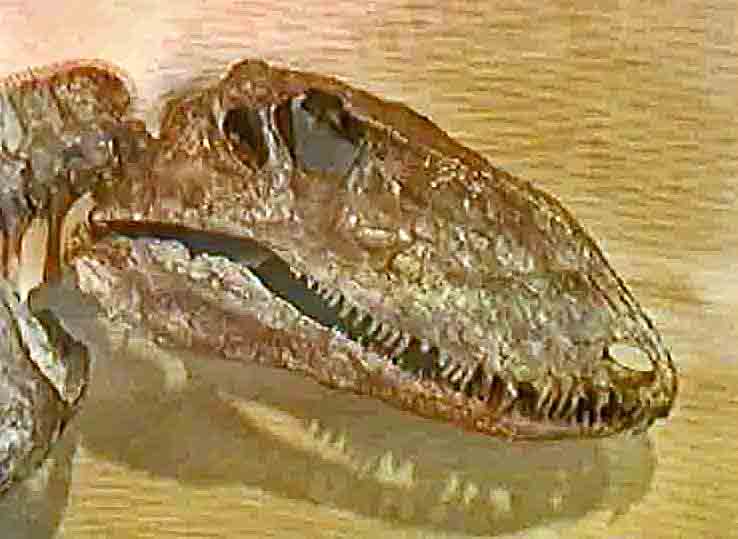
Early synapsid — Ophiacodon uniformis
Geologic period: Early Permian
Age: Approximately 286 to 284 million years ago for the Smithsonian Deep Time specimen.
Feeding: Predatory feeding is inferred from skull and tooth anatomy rather than directly observed behavior.
Locomotion: Terrestrial quadrupedal locomotion.
Body plan: Long-bodied quadrupedal early synapsid with a relatively large skull and sprawling limbs.
Evidence: Skeleton, skull and teeth provide direct anatomical evidence. Diet and behavior are reconstructed from anatomy.
Why it matters: Ophiacodon helps introduce the synapsid lineage—the great evolutionary branch that eventually includes mammals.
Plain Language Identity: An Early Permian synapsid from the branch of vertebrate evolution more closely related to mammals than to dinosaurs or modern reptiles.
What You Are Looking At: A fossil skeleton of Ophiacodon uniformis. Smithsonian notes that rapid burial preserved the individual in its death pose.
Ecosystem: Early Permian terrestrial ecosystem of what is now Texas.
Preservation: Articulated or associated skeletal fossil.
Find Location: Texas, United States.
Open Questions: Do not call Ophiacodon a dinosaur. Dinosaurs had not yet evolved, and Ophiacodon belongs to Synapsida.
Source Urls: https://naturalhistory.si.edu/visit/virtual-tour/current-exhibits/deep-time-virtual-tour-fossil-list; https://www.si.edu/newsdesk/factsheets/david-h-koch-hall-fossils-deep-time
Enrichment Method: SAGE curated research pass; title and scientific name matched; current research distinctions retained; evidence separated from inference
Scientific name: Ophiacodon uniformis
Evidence / representation: comparative_taxon_visual
comparative_taxon_visual
The Permian World: Strange Bodies and the Great Dying.
Media license: CC BY-SA 3.0
https://creativecommons.org/licenses/by-sa/3.0
This object page stays inside SAGE Museum. The Smithsonian link below is provided only as the original scholarly collection record. It opens separately.
VIEW ORIGINAL SMITHSONIAN RECORD ↗