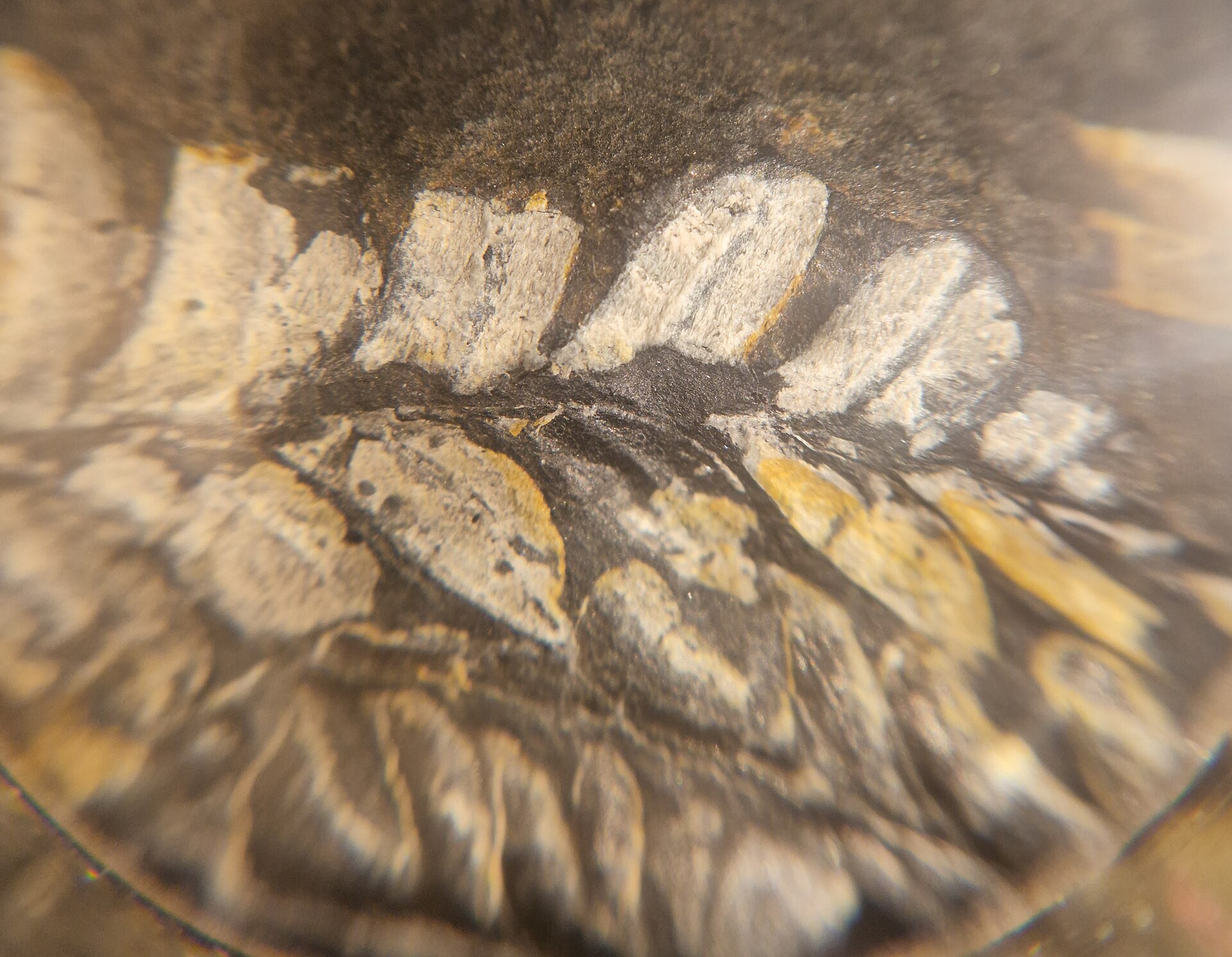
Medullosan seed fern — Alethopteris serlii
Geologic period: Late Carboniferous — Pennsylvanian
Age: Late Carboniferous.
Feeding: Photosynthetic plant.
Body plan: Large seed-fern plant with compound frond-like foliage.
Evidence: Leaf shape and venation are direct fossil evidence. The complete medullosan plant is reconstructed by combining separately preserved organs.
Why it matters: Seed ferns looked superficially fern-like but reproduced with seeds, showing that appearance alone does not tell us how an ancient plant reproduced.
Plain Language Identity: Foliage from an extinct medullosan seed fern of Carboniferous forests.
What You Are Looking At: A fragment of foliage preserving the characteristic pinnules and venation of Alethopteris serlii.
Ecosystem: Carboniferous terrestrial vegetation, including coal-forming landscapes.
Preservation: Leaf compression or impression.
Find Location: Smithsonian education specimens of Alethopteris serlii include material from Pennsylvania.
Open Questions: The leaf fragment alone is not a complete plant and should not be labeled simply as a true fern.
Source Urls: https://naturalhistory.si.edu/visit/virtual-tour/current-exhibits/deep-time-virtual-tour-fossil-list; https://www.si.edu/object/fossil-seed-fern-fossil-seed-fern:nmnheducation_10019994; https://qrius.si.edu/browse/object/10019703
Enrichment Method: SAGE curated research pass; title and scientific name matched; evidence separated from inference
Scientific name: Alethopteris serlii
Evidence / representation: comparative_exact_taxon_visual
comparative_exact_taxon_visual
Life Conquers the Land: Forests, Fishes and the First Four-Legged Worlds.
Media license: CC0
http://creativecommons.org/publicdomain/zero/1.0/deed.en
This object page stays inside SAGE Museum. The Smithsonian link below is provided only as the original scholarly collection record. It opens separately.
VIEW ORIGINAL SMITHSONIAN RECORD ↗