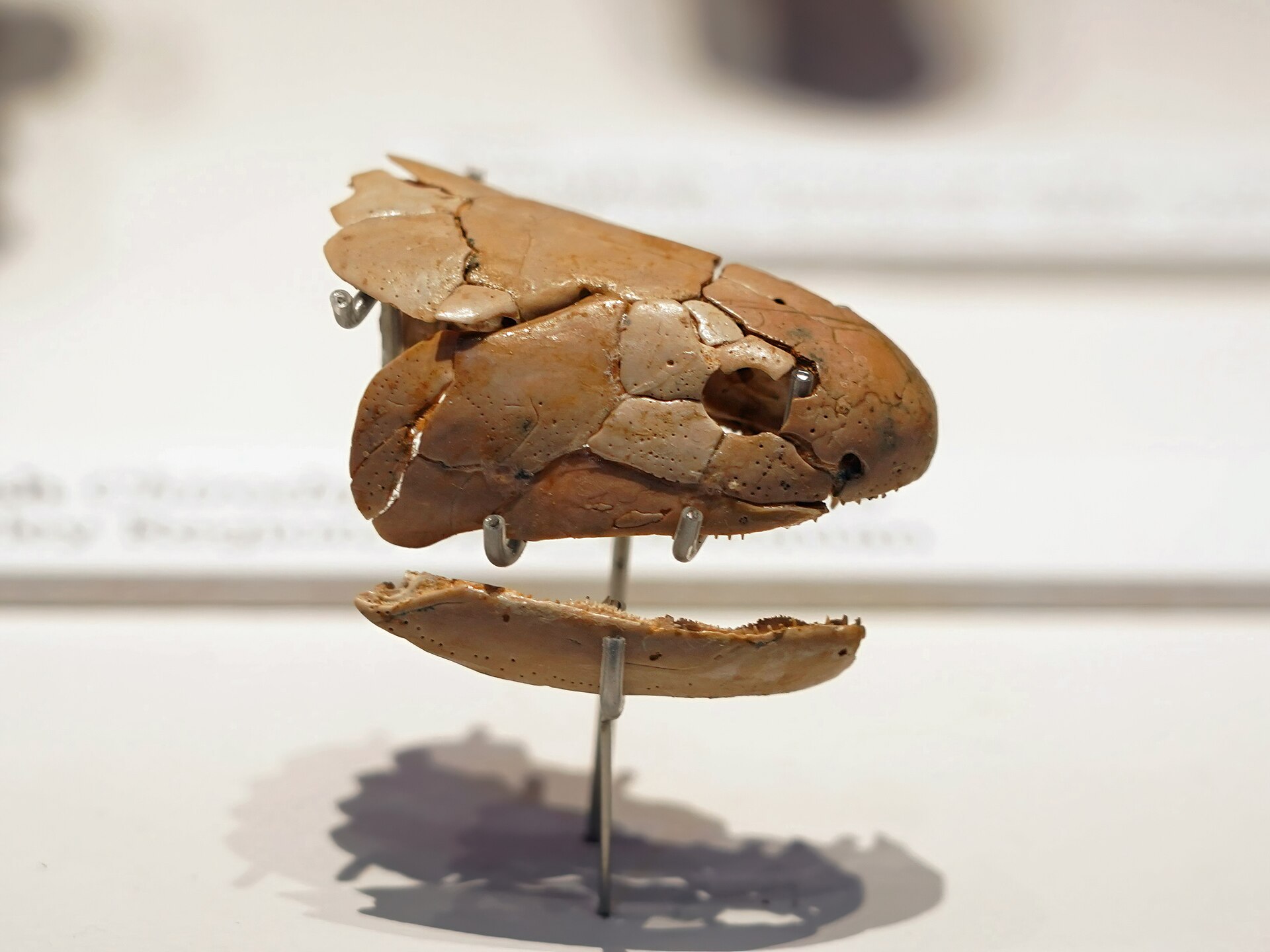
Lobe-finned bony fish — Gogonasus andrewsae
Geologic period: Late Devonian
Age: Approximately 375 million years ago.
Feeding: Predatory feeding is inferred from fish anatomy.
Locomotion: Aquatic swimming using paired and median fins.
Body plan: Lobe-finned fish with robust internal fin bones and a skull showing features relevant to tetrapod origins.
Evidence: Skull and fin anatomy provide direct evidence; evolutionary placement comes from comparative analysis.
Why it matters: Gogonasus preserves anatomical clues important for understanding the evolutionary transition from lobe-finned fishes toward tetrapods.
Plain Language Identity: A Late Devonian lobe-finned fish from Australia's famous Gogo fossil deposits.
What You Are Looking At: A cast representing the skull anatomy of Gogonasus.
Ecosystem: Tropical Devonian reef environment in what is now Western Australia.
Preservation: The visitor object is a cast based on exceptionally preserved fossil material.
Find Location: Gogo Formation region, Western Australia.
Open Questions: Do not portray Gogonasus as a land animal or as a single direct ancestor of tetrapods.
Source Urls: https://naturalhistory.si.edu/visit/virtual-tour/current-exhibits/deep-time-virtual-tour-fossil-list; https://museumsvictoria.com.au/melbournemuseum/resources/600-million-years/
Enrichment Method: SAGE curated research pass; title and scientific name matched; evidence separated from inference
Scientific name: Gogonasus andrewsae
Evidence / representation: comparative_exact_taxon_visual
comparative_exact_taxon_visual
Oceans Before Dinosaurs: The Rise of Complex Animal Life.
Media license: CC BY-SA 4.0
https://creativecommons.org/licenses/by-sa/4.0
This object page stays inside SAGE Museum. The Smithsonian link below is provided only as the original scholarly collection record. It opens separately.
VIEW ORIGINAL SMITHSONIAN RECORD ↗