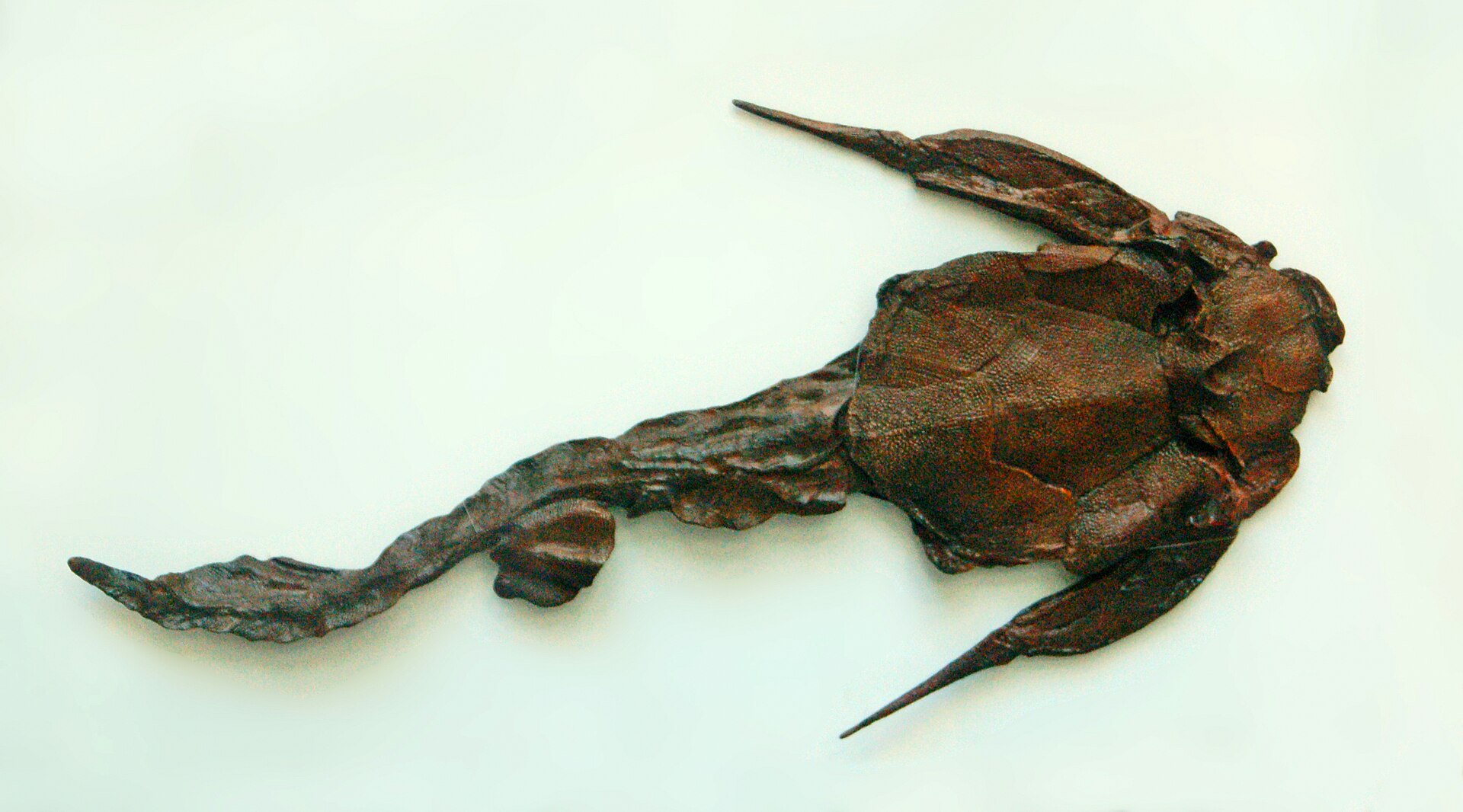
Placoderm fish — Bothriolepis canadensis
Geologic period: Late Devonian
Age: Late Devonian.
Feeding: Detailed diet is not assigned from this specimen alone.
Locomotion: Aquatic vertebrate.
Body plan: Armored head and trunk with jointed pectoral appendages.
Evidence: Dermal armor and skeletal anatomy are directly preserved.
Why it matters: Bothriolepis shows the extraordinary diversity of armored jawed fishes that flourished during the Devonian.
Plain Language Identity: An armored Late Devonian placoderm fish belonging to the antiarch group.
What You Are Looking At: Mineralized dermal armor from a fish whose head and front body were enclosed by bony plates.
Ecosystem: Late Devonian aquatic ecosystem.
Preservation: Mineralized dermal bone.
Formation: Escuminac Formation is represented among Smithsonian specimens.
Find Location: Quebec, Canada.
Open Questions: Do not reconstruct behavior solely from the armor.
Source Urls: https://naturalhistory.si.edu/visit/virtual-tour/current-exhibits/deep-time-virtual-tour-fossil-list; https://www.si.edu/object/nmnhpaleobiology_3423796
Enrichment Method: SAGE curated research pass; title and scientific name matched; evidence separated from inference
Scientific name: Bothriolepis canadensis
Evidence / representation: comparative_exact_taxon_visual
comparative_exact_taxon_visual
Oceans Before Dinosaurs: The Rise of Complex Animal Life.
Media license: CC BY-SA 3.0
https://creativecommons.org/licenses/by-sa/3.0
This object page stays inside SAGE Museum. The Smithsonian link below is provided only as the original scholarly collection record. It opens separately.
VIEW ORIGINAL SMITHSONIAN RECORD ↗