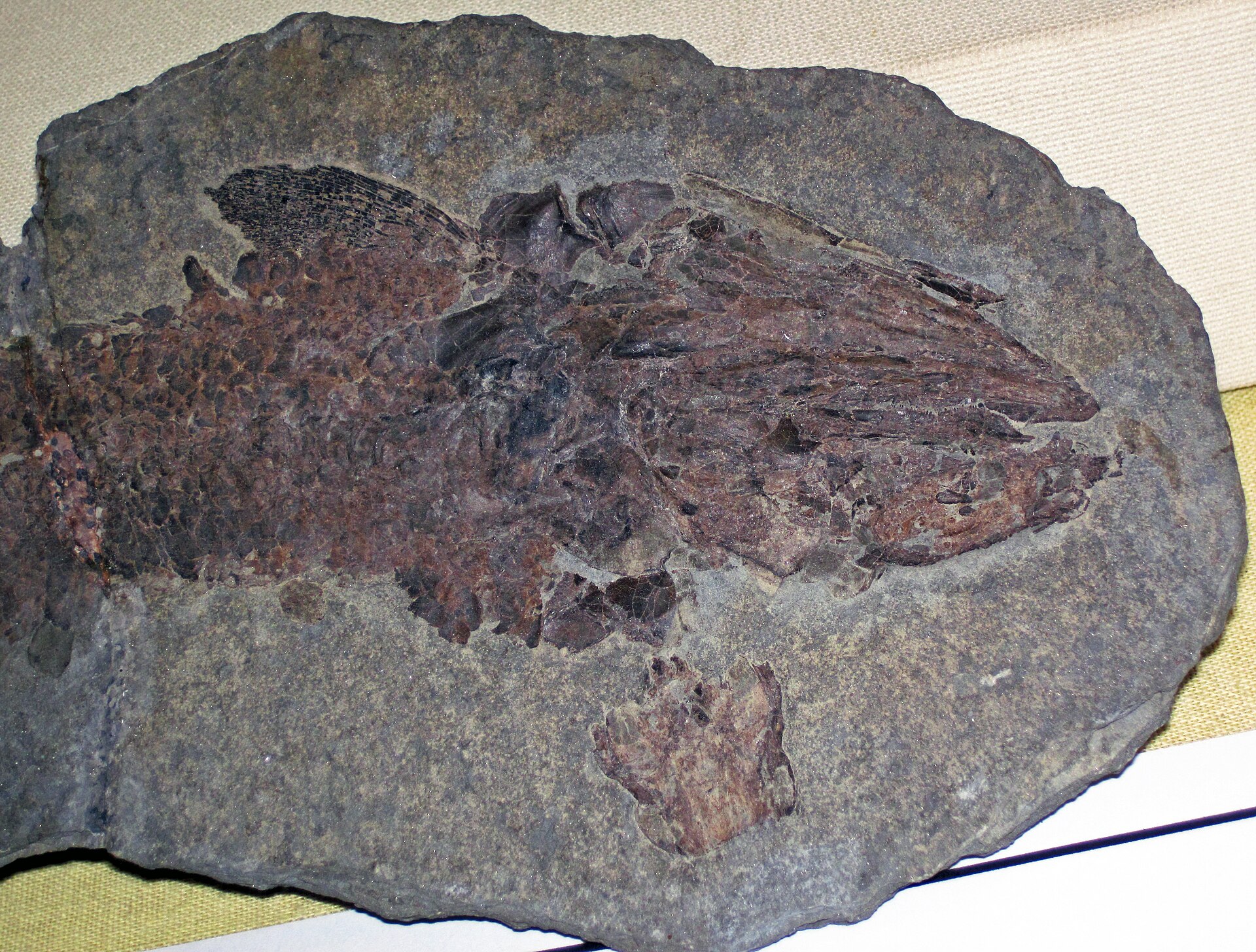
Lobe-finned fish — Eusthenopteron foordi
Geologic period: Late Devonian
Age: Late Devonian.
Feeding: Predatory ecology is inferred from skull and tooth anatomy.
Locomotion: Aquatic swimming using fins; it was not a walking land tetrapod.
Body plan: Fish body with robust internal bones inside paired fleshy fins.
Evidence: Skull and skeletal anatomy are direct. Its evolutionary relationship is reconstructed through comparative anatomy.
Why it matters: Eusthenopteron helped scientists recognize anatomical links between lobe-finned fishes and early tetrapods.
Plain Language Identity: A Late Devonian lobe-finned fish closely related to the branch of vertebrates that eventually produced tetrapods.
What You Are Looking At: A fossil skull from a sarcopterygian, or lobe-finned fish.
Ecosystem: Late Devonian aquatic ecosystem.
Preservation: Mineralized vertebrate skull fossil.
Formation: Escuminac Formation for well-documented Smithsonian material.
Find Location: Quebec, Canada.
Open Questions: Do not describe Eusthenopteron as the direct ancestor of all land vertebrates.
Source Urls: https://naturalhistory.si.edu/visit/virtual-tour/current-exhibits/deep-time-virtual-tour-fossil-list; https://www.si.edu/object/nmnhpaleobiology_3414848
Enrichment Method: SAGE curated research pass; title and scientific name matched; evidence separated from inference
Scientific name: Eusthenopteron foordi
Evidence / representation: comparative_exact_taxon_visual
comparative_exact_taxon_visual
Oceans Before Dinosaurs: The Rise of Complex Animal Life.
Media license: CC BY 2.0
https://creativecommons.org/licenses/by/2.0
This object page stays inside SAGE Museum. The Smithsonian link below is provided only as the original scholarly collection record. It opens separately.
VIEW ORIGINAL SMITHSONIAN RECORD ↗