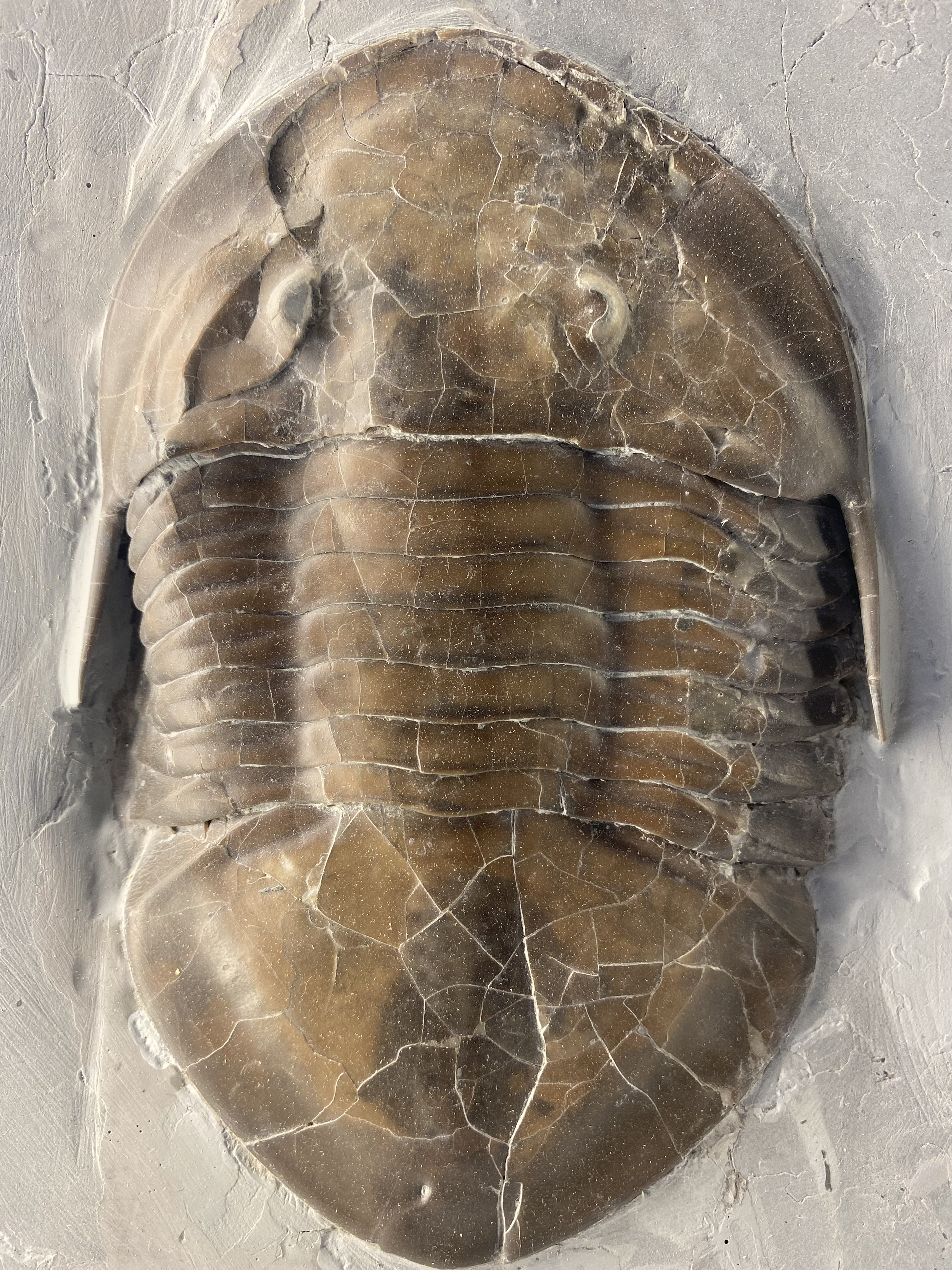
Trilobite — Isotelus gigas
Geologic period: Late Ordovician
Age: Late Ordovician; Smithsonian material includes Cincinnatian and Trentonian occurrences.
Feeding: Specific feeding behavior is not assigned from this display specimen alone.
Locomotion: Walking across or near the seafloor using paired limbs, known from trilobite anatomy.
Body plan: Broad cephalon, segmented thorax and pygidium forming the classic three-part trilobite body.
Evidence: Exoskeleton anatomy is direct. Limb and behavior reconstructions draw on exceptional trilobite fossils and comparative anatomy.
Why it matters: Isotelus represents one of the most recognizable successful arthropod designs of Paleozoic seas.
Plain Language Identity: A large asaphid trilobite from Ordovician seas.
What You Are Looking At: The mineralized external skeleton of an extinct marine arthropod.
Ecosystem: Ordovician marine seafloor.
Preservation: Mineralized exoskeleton.
Open Questions: A fossil exoskeleton should not be mistaken for the complete original animal including soft tissues.
Source Urls: https://naturalhistory.si.edu/visit/virtual-tour/current-exhibits/deep-time-virtual-tour-fossil-list; https://www.si.edu/object/isotelus-gigas-dekay:nmnhpaleobiology_3021122
Enrichment Method: SAGE curated research pass; title and scientific name matched; evidence separated from inference
Scientific name: Isotelus gigas
Evidence / representation: comparative_exact_taxon_visual
comparative_exact_taxon_visual
Oceans Before Dinosaurs: The Rise of Complex Animal Life.
Media license: CC0
http://creativecommons.org/publicdomain/zero/1.0/deed.en
This object page stays inside SAGE Museum. The Smithsonian link below is provided only as the original scholarly collection record. It opens separately.
VIEW ORIGINAL SMITHSONIAN RECORD ↗