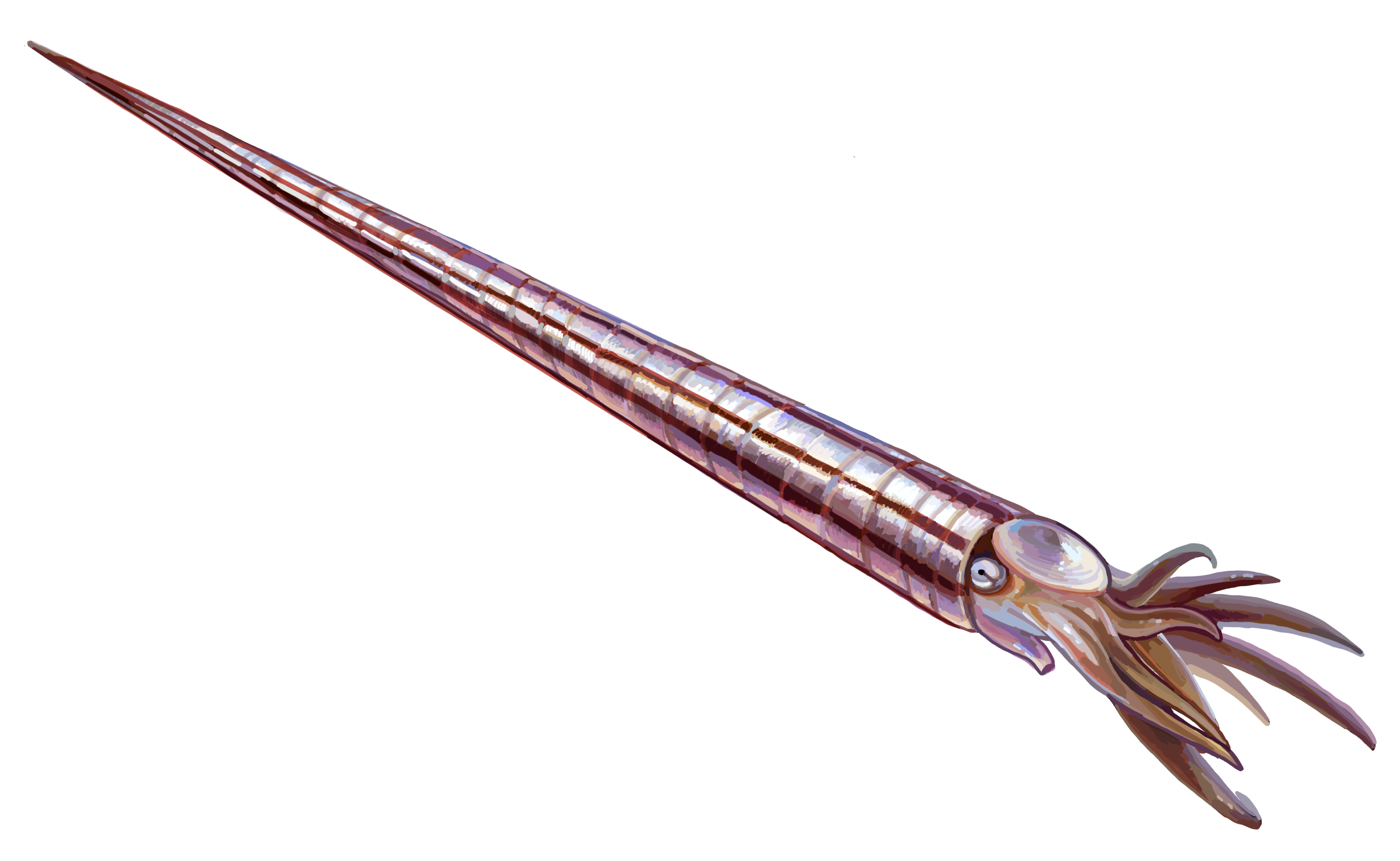
Orthocone cephalopod — Endoceras sp.
Geologic period: Ordovician
Age: Ordovician; exact numeric age of the Smithsonian display shell is not assigned here.
Feeding: Predatory or scavenging ecology is reconstructed from cephalopod biology and associated anatomy, not directly preserved by the shell alone.
Body plan: Orthoconic chambered external shell.
Evidence: Shell geometry and chambers are direct fossil evidence. Soft-body appearance is reconstructed.
Why it matters: Large straight-shelled cephalopods were prominent members of Paleozoic oceans long before coiled ammonites became famous.
Plain Language Identity: A straight-shelled marine cephalopod relative of later nautiloids, ammonoids, squid and octopuses.
What You Are Looking At: A long straight chambered shell rather than the animal's soft body.
Ecosystem: Ordovician marine ecosystem.
Preservation: Mineralized shell fossil.
Open Questions: Do not depict exact coloration or soft anatomy as observed fact.
Source Urls: https://naturalhistory.si.edu/visit/virtual-tour/current-exhibits/deep-time-virtual-tour-fossil-list; https://collections.st-andrews.ac.uk/item/endoceras-sp/871306
Enrichment Method: SAGE curated research pass; title and scientific name matched; evidence separated from inference
Scientific name: Endoceras sp.
Evidence / representation: comparative_exact_taxon_visual
comparative_exact_taxon_visual
Oceans Before Dinosaurs: The Rise of Complex Animal Life.
Media license: CC BY-SA 4.0
https://creativecommons.org/licenses/by-sa/4.0
This object page stays inside SAGE Museum. The Smithsonian link below is provided only as the original scholarly collection record. It opens separately.
VIEW ORIGINAL SMITHSONIAN RECORD ↗