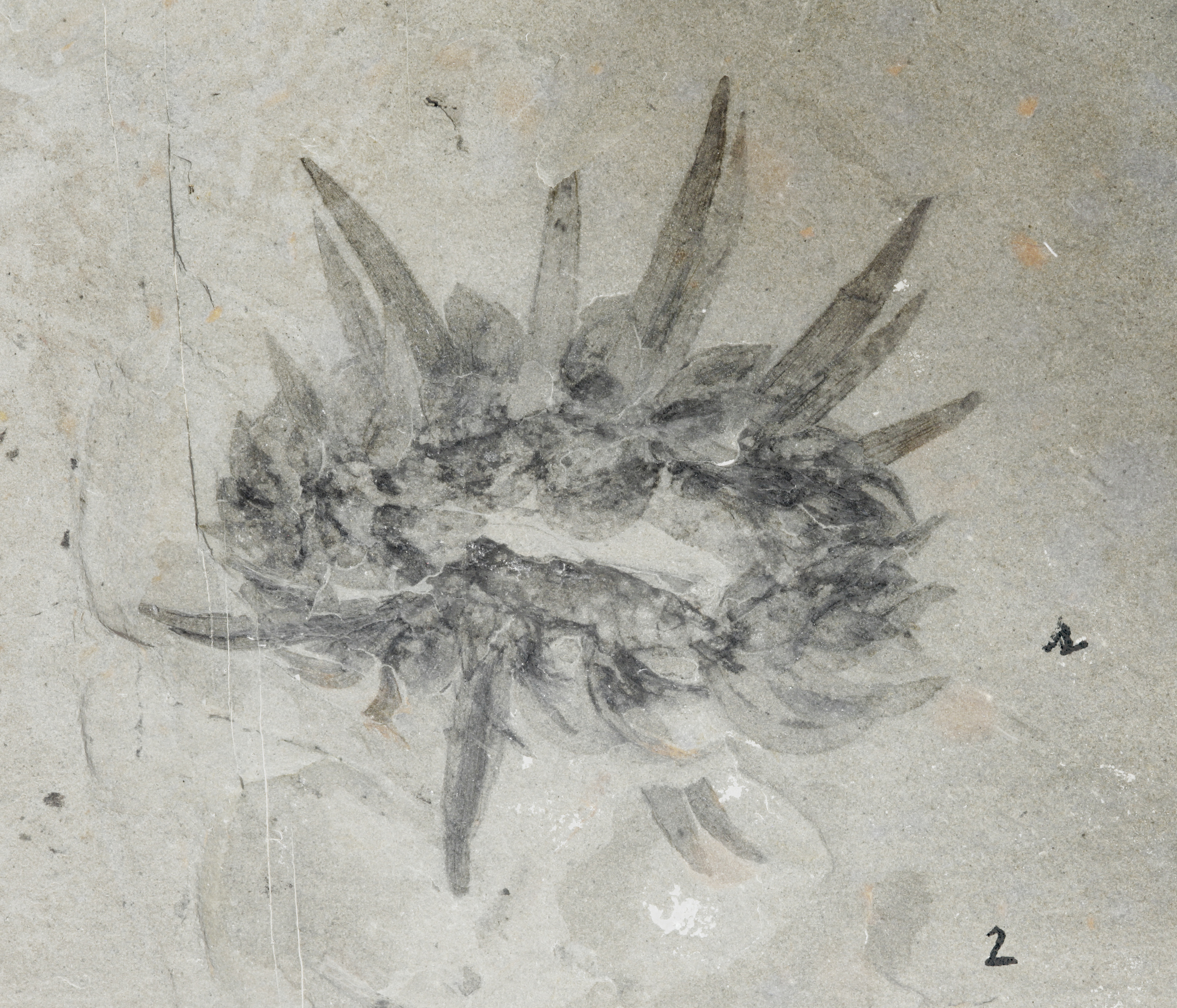
Early mollusk — Wiwaxia corrugata
Geologic period: Middle Cambrian
Age: Approximately 505 million years ago.
Feeding: A radula-like feeding apparatus suggests grazing or scraping food from surfaces.
Locomotion: Movement along the seafloor is inferred from body form.
Body plan: Slug-like body covered with scales and defensive spines.
Evidence: Sclerites, spines and mouth structures are directly preserved. Its exact position on the animal family tree remains interpretive.
Why it matters: Wiwaxia sits near major questions about the early evolution of mollusks and related animal groups.
Plain Language Identity: A small armored Cambrian animal traditionally compared with mollusks but whose exact evolutionary position has been debated.
What You Are Looking At: A soft-bodied animal protected by rows of hard sclerites and prominent spines.
Ecosystem: Burgess Shale marine ecosystem.
Preservation: Exceptional soft-body and hard-part preservation.
Open Questions: Do not present 'mollusk' as an uncontested final classification.
Source Urls: https://naturalhistory.si.edu/visit/virtual-tour/current-exhibits/deep-time-virtual-tour-fossil-list; https://burgess-shale.rom.on.ca/fossils/wiwaxia-corrugata/
Enrichment Method: SAGE curated research pass; title and scientific name matched; evidence separated from inference
Scientific name: Wiwaxia corrugata
Evidence / representation: comparative_exact_taxon_visual
comparative_exact_taxon_visual
Oceans Before Dinosaurs: The Rise of Complex Animal Life.
Media license: CC0
http://creativecommons.org/publicdomain/zero/1.0/deed.en
This object page stays inside SAGE Museum. The Smithsonian link below is provided only as the original scholarly collection record. It opens separately.
VIEW ORIGINAL SMITHSONIAN RECORD ↗