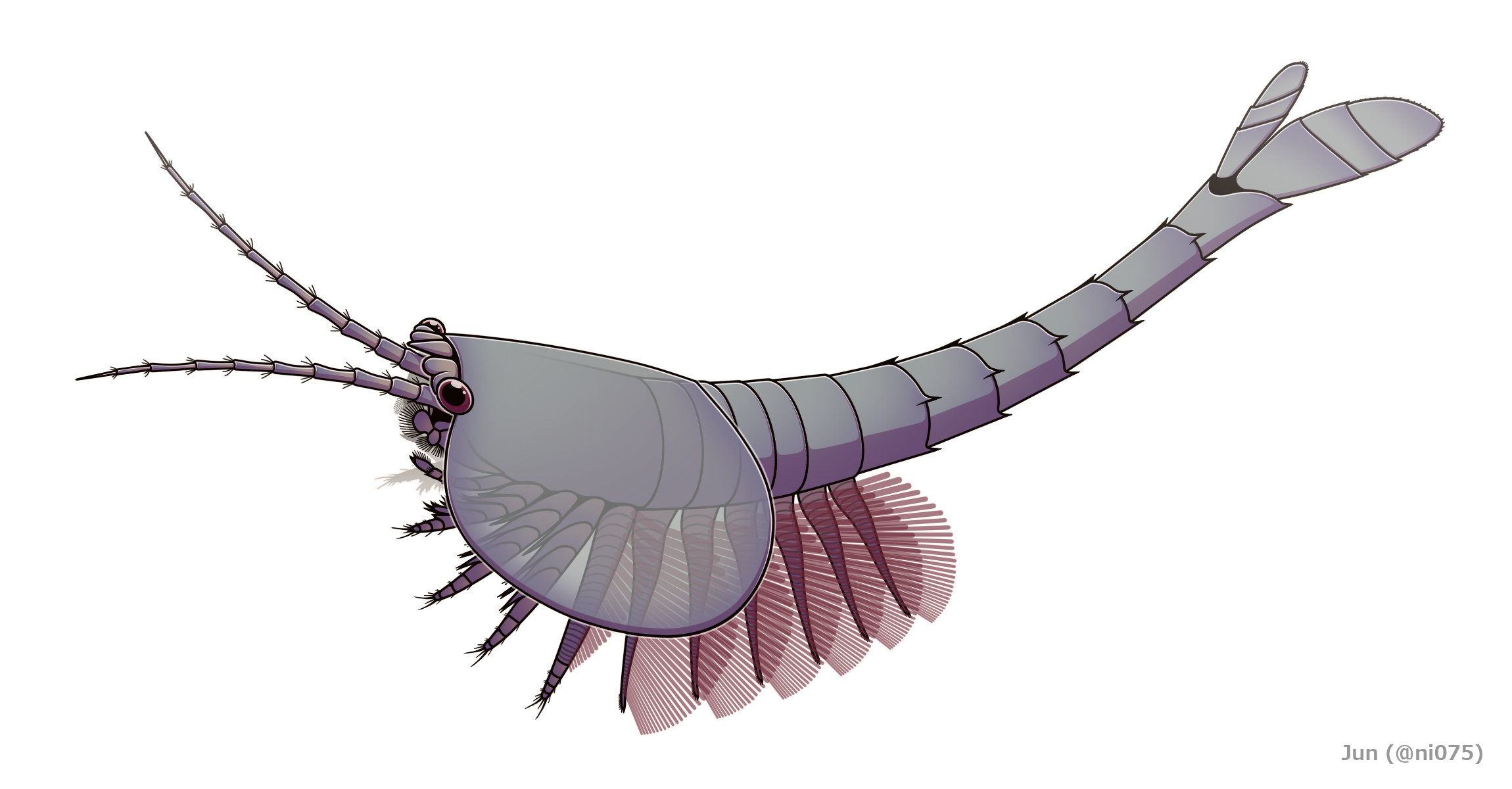
Early arthropod — Waptia fieldensis
Geologic period: Middle Cambrian
Age: Approximately 505 million years ago.
Feeding: Diet should be treated as ecological interpretation rather than something directly demonstrated by every specimen.
Locomotion: Appendage anatomy supports active movement through or along the marine environment.
Body plan: Bivalved carapace covering the front of a segmented arthropod body with paired appendages.
Evidence: Complete specimens preserve appendages and, in some cases, gut contents.
Why it matters: Waptia preserves delicate anatomy that normally disappears, making it important for understanding early arthropod evolution.
Plain Language Identity: A bivalved Cambrian arthropod from the Burgess Shale.
What You Are Looking At: A segmented arthropod body with a carapace, antennae, appendages and trunk structures that can be preserved with exceptional detail.
Ecosystem: Burgess Shale marine ecosystem.
Preservation: Exceptional Burgess Shale soft-body preservation.
Open Questions: Do not assign behavior to the Smithsonian specimen unless that behavior is supported by the actual fossil evidence.
Source Urls: https://naturalhistory.si.edu/visit/virtual-tour/current-exhibits/deep-time-virtual-tour-fossil-list; https://burgess-shale.rom.on.ca/fossils/waptia-fieldensis/
Enrichment Method: SAGE curated research pass; title and scientific name matched; evidence separated from inference
Scientific name: Waptia fieldensis
Evidence / representation: comparative_exact_taxon_visual
comparative_exact_taxon_visual
Oceans Before Dinosaurs: The Rise of Complex Animal Life.
Media license: CC BY-SA 4.0
https://creativecommons.org/licenses/by-sa/4.0
This object page stays inside SAGE Museum. The Smithsonian link below is provided only as the original scholarly collection record. It opens separately.
VIEW ORIGINAL SMITHSONIAN RECORD ↗