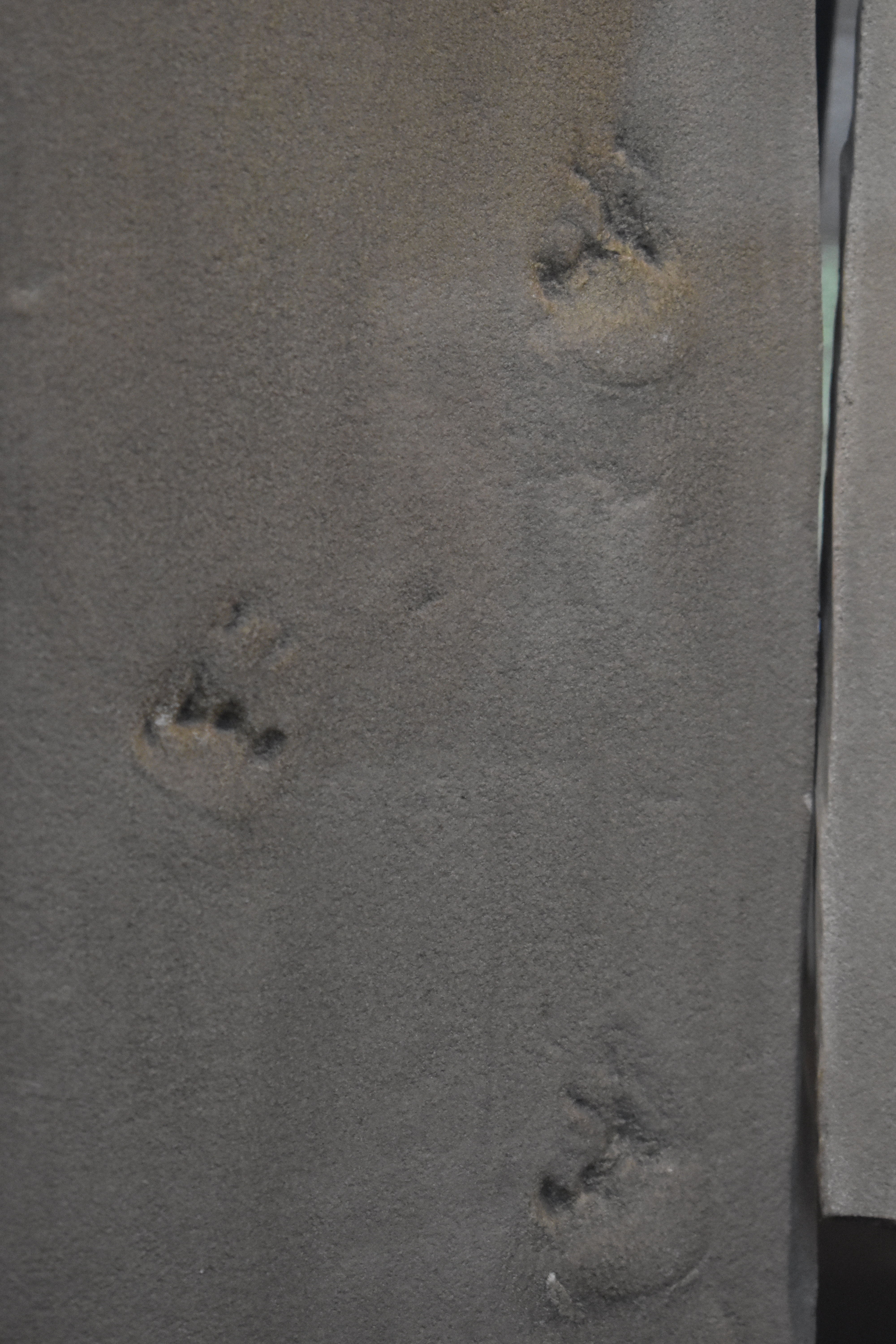
Synapsid tetrapod — Chelichnus bucklandi
Geologic period: Permian
Age: Permian; exact age of the Smithsonian display trackway is not established in the current verified source set.
Feeding: Cannot be determined from this trackway alone.
Locomotion: Walking tetrapod movement is directly recorded by the sequence of footprints.
Body plan: Body not preserved; only trace evidence is present.
Evidence: Footprint shape and trackway geometry are direct evidence. Exact biological trackmaker identity is less certain than identification from body fossils.
Why it matters: Trackways preserve behavior that bones often cannot, including movement, foot placement and interaction with the ground.
Plain Language Identity: A Permian tetrapod trace fossil classified as Chelichnus bucklandi.
What You Are Looking At: A sequence of fossil footprints — evidence of an animal moving across an ancient surface rather than the animal's body.
Preservation: Trace fossil / trackway.
Open Questions: Do not present a particular animal reconstruction as the confirmed maker of the tracks.
Source Urls: https://naturalhistory.si.edu/visit/virtual-tour/current-exhibits/deep-time-virtual-tour-fossil-list
Enrichment Method: SAGE curated research pass; evidence separated from inference
Scientific name: Chelichnus bucklandi
Evidence / representation: comparative_trace_fossil_visual
comparative_trace_fossil_visual
Reading Deep Time: How Rocks, Fossils and Time Become Evidence.
Media license: CC BY-SA 4.0
https://creativecommons.org/licenses/by-sa/4.0
This object page stays inside SAGE Museum. The Smithsonian link below is provided only as the original scholarly collection record. It opens separately.
VIEW ORIGINAL SMITHSONIAN RECORD ↗