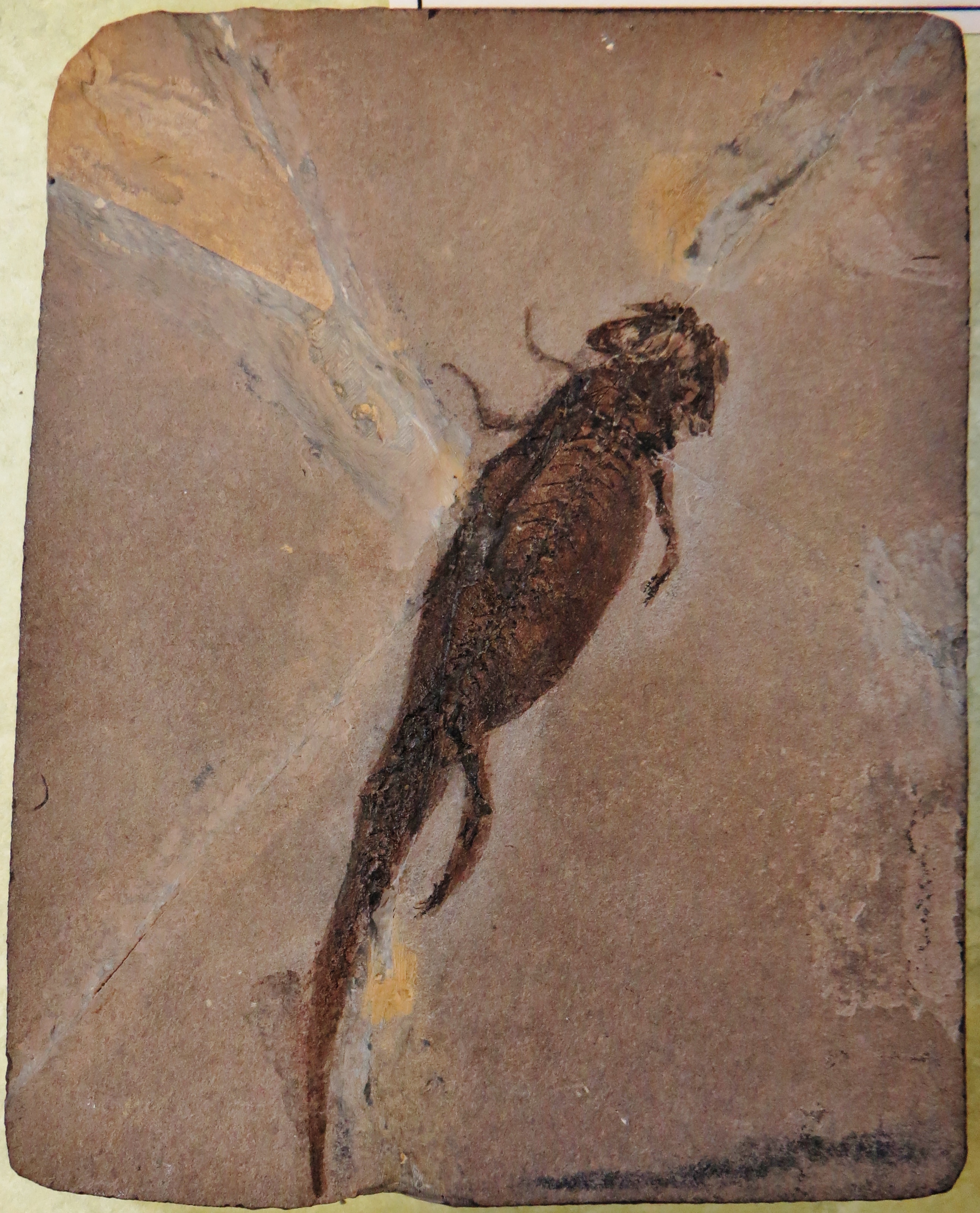
Early amphibians — Apateon pedestris
Geologic period: Early Permian
Age: Early Permian; the cited Smithsonian catalog entry does not provide a single numeric age.
Feeding: Not assigned here because the displayed fossil does not directly record diet.
Locomotion: Not presented as direct evidence from this specimen.
Body plan: Small temnospondyl amphibian skeleton.
Evidence: Smithsonian catalog data establish age, formation, locality and skeletal preservation.
Why it matters: Apateon provides a window into small amphibian life in Permian freshwater ecosystems and shows how much an articulated body fossil can preserve.
Plain Language Identity: A small early Permian amphibian, Apateon pedestris.
What You Are Looking At: A preserved Apateon pedestris skeleton.
Formation: Meisenheim Formation
Find Location: Rheinland-Pfalz, Germany
Preservation: Skeleton preserved in matrix.
Open Questions: Behavior and life history remain separate from what the skeleton itself directly demonstrates.
Source Urls: https://naturalhistory.si.edu/visit/virtual-tour/current-exhibits/deep-time-virtual-tour-fossil-list; https://www.si.edu/object/nmnhpaleobiology_3342077
Enrichment Method: SAGE curated research pass; evidence separated from inference
Scientific name: Apateon pedestris
Evidence / representation: comparative_exact_taxon_visual
comparative_exact_taxon_visual
Reading Deep Time: How Rocks, Fossils and Time Become Evidence.
Media license: CC BY-SA 4.0
https://creativecommons.org/licenses/by-sa/4.0/
This object page stays inside SAGE Museum. The Smithsonian link below is provided only as the original scholarly collection record. It opens separately.
VIEW ORIGINAL SMITHSONIAN RECORD ↗